


At Watches and Wonders Geneva 2026, Audemars Piguet showed three watches unlike anything else at the fair. Each one has been made entirely by hand, brought together by a network of independent craftspeople, and together they mark the first pieces to emerge from the Atelier des Établisseurs. It is a project built on a simple but powerful idea: what happens when watchmaking returns to its roots.
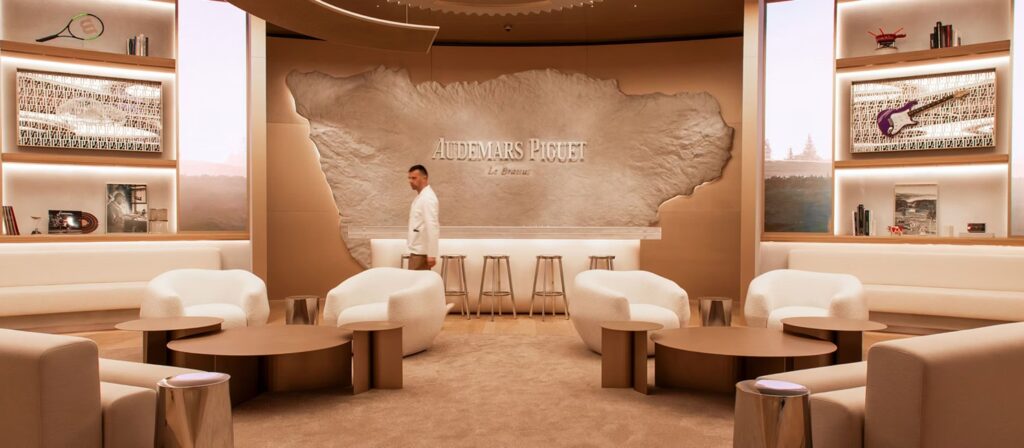
First introduced in 2024, the Atelier des Établisseurs looks back to a time before modern production, when watches were created slowly, across different workshops in the Swiss Jura. Each specialist focused on their own craft, passing components from one maker to the next until the final piece came together. It was a way of working that required trust, patience and extraordinary skill, and it produced some of the most intricate watches ever made.
The three watches revealed this year are the first to bring that approach to life. Each has been created by a different group of artisans, each highlights a rare and often disappearing craft, and each is produced in very small numbers. That sense of rarity is not just part of the process, it is part of the charm. These are watches shaped by human hands at every stage, offering something that feels increasingly special: a genuine connection to the people and the craft behind them.
The method and revival
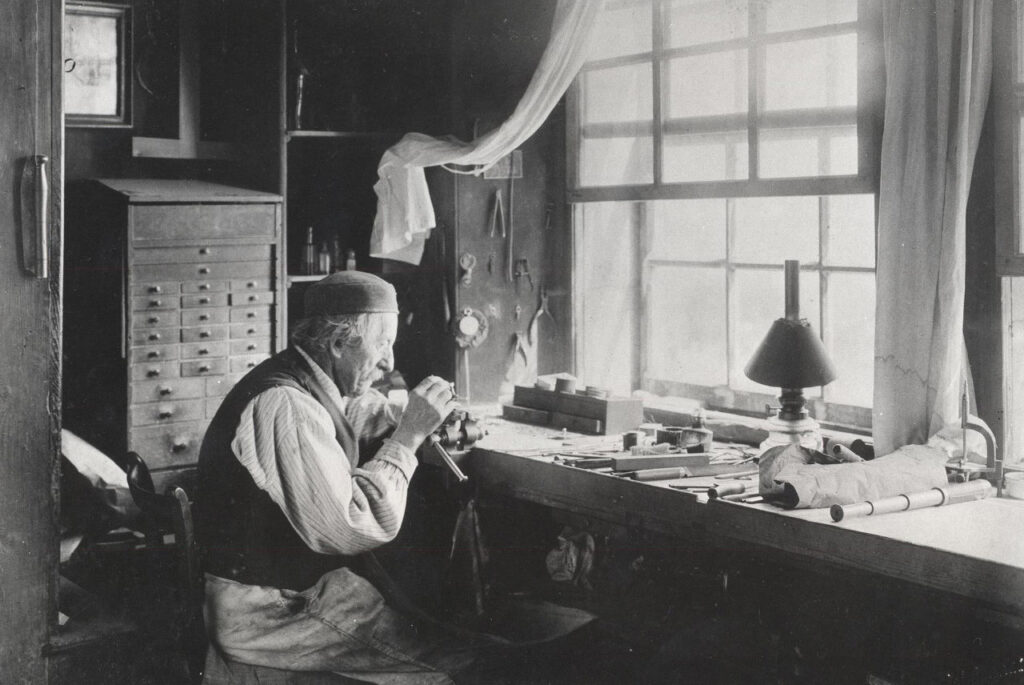
Etablissage is a French term with no straight English equivalent. The system it describes grew out of the mountain communities of the Vallee de Joux, where in the 18th century it was not practical to train a single watchmaker in every aspect of the craft. Instead, different workshops each became expert in one area: one made movement bases, another added complications, another produced dials, another made cases. An etablisseur coordinated the work, sourced the parts, and assembled the final piece. The whole operation ran on brass templates, personal relationships, and a good deal of mutual trust.

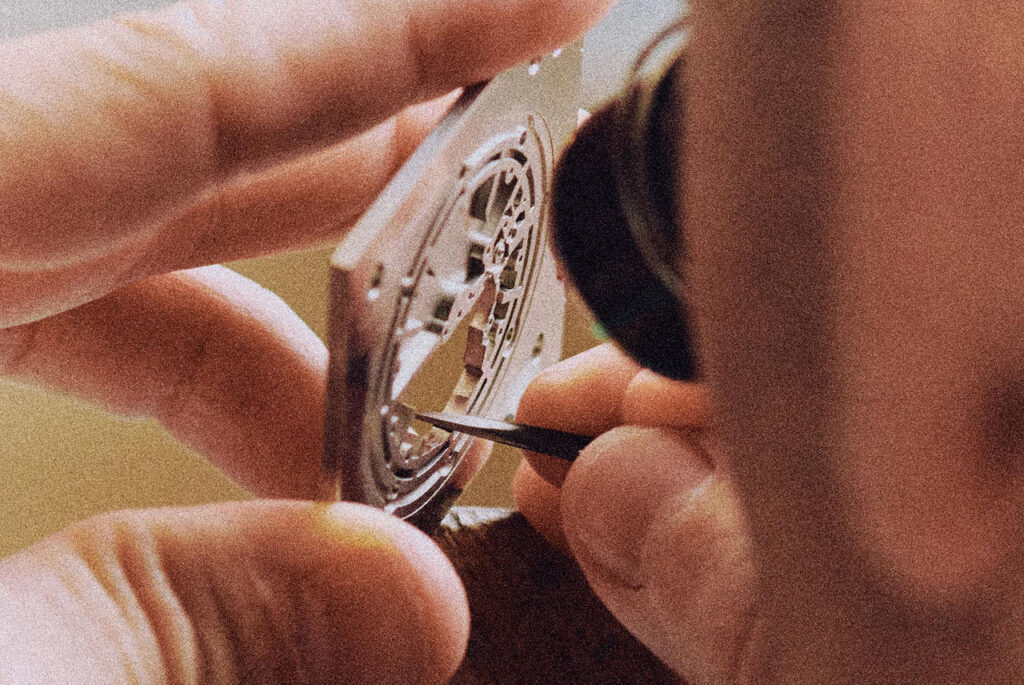
It produced extraordinary results. The Grosse Piece, a pocket watch with nearly 20 complications that first appeared in the Audemars Piguet records on 22 April 1914, is a good example. Its movement blank came from Charles Piguet, a local specialist known informally as the Emperor. The striking mechanism was made by the sons of Louis Elisee Piguet. The perpetual calendar points clearly to dial-maker Leon Aubert, whose apprentice later contributed to the creation of the Henry Graves watch for Patek Philippe in 1933.
The tourbillon came from Jules Cesar Capt. English craftsmen Frederick Thoms and Thomas Willis handled the case and dial. The watch took the better part of a decade to finish, delayed in part by the First World War. It sold at the Geneva Fair in 1920 for the reported price of a London house, was auctioned by Sotheby’s New York in December 2025, and now sits in the Audemars Piguet Heritage Collection.
The system faded with industrialisation and had largely disappeared by the late 20th century. The decision to revive it came March 2024, when chief executive Ilaria Resta, three months into the role, was reviewing a collection of vintage pieces with heritage director Sebastian Vivas and asked whether something like them could be made today. Vivas explained the conditions that produced those watches no longer existed. Resta treated that as a starting point rather than a conclusion, asked who could bring the approach back, and gave Vivas a week to decide if he wanted to run it. Board approval followed in May 2024.
The Etablisseurs Galets
The Lac de Joux is a few kilometres from Le Brassus, where Audemars Piguet has been based since 1875. Its shoreline is covered in small, smooth pebbles, and this gave independent designer Xavier J. Perrenoud the idea for the first watch. The bracelet is made up of links that are each slightly different in shape, reflecting the fact that no two pebbles are alike. Connecting them in a way that holds together and moves comfortably on a wrist was a practical problem that Geneva jeweller Nadia Morgenthaler resolved with small ball joints, developed over several rounds of testing.
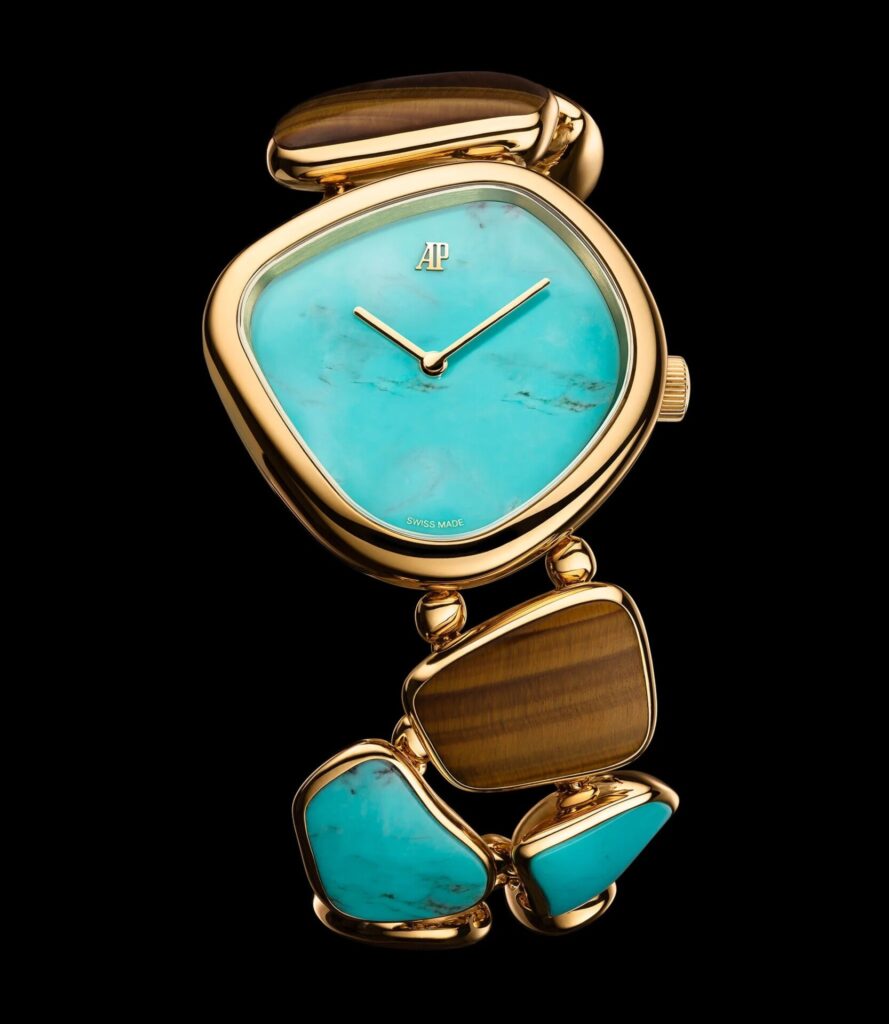
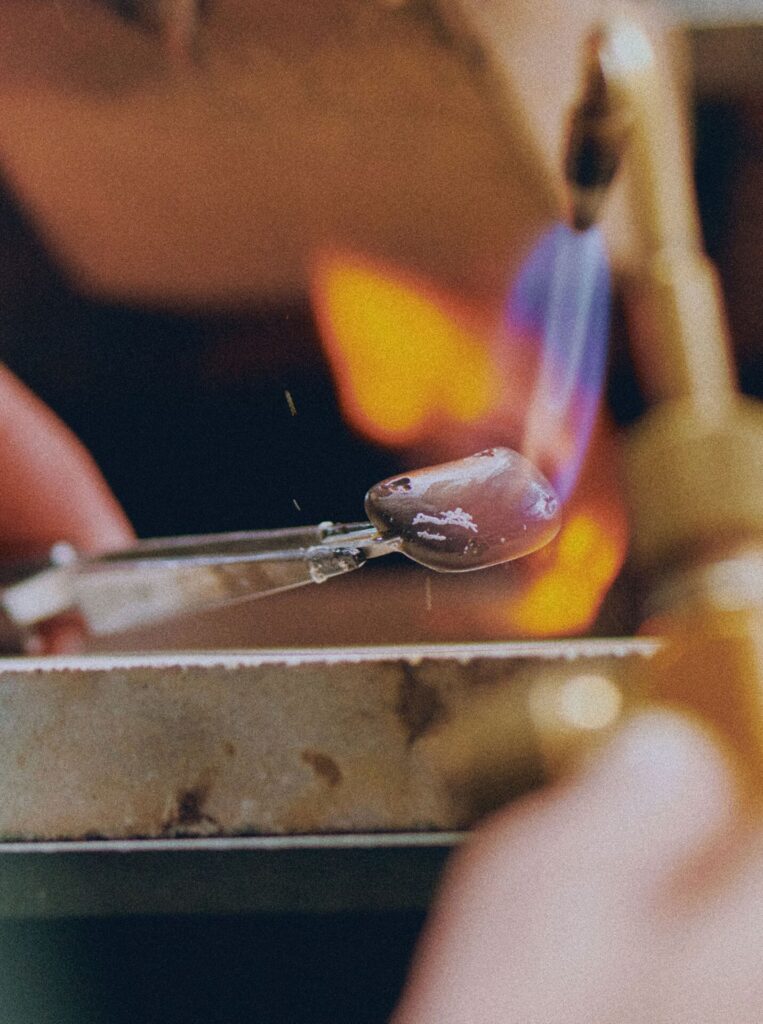
The gold links are hollowed out to reduce weight and set with semi-precious stones cut by Mario Senape in Cossonay. Constructor Arthur Gallezot reworked the movement bridges to follow the rounded, irregular shapes of the concept. Luca Soprana in Montmollin applied a frosted finish using a technique older than sandblasting that produces a finer surface. The stone dial is fitted into an asymmetric oval case made by Theo Massouatis and Pablo Brenlla in Plan-Les-Ouates. The watch runs on Calibre 3098 and will be produced in very limited numbers each year.
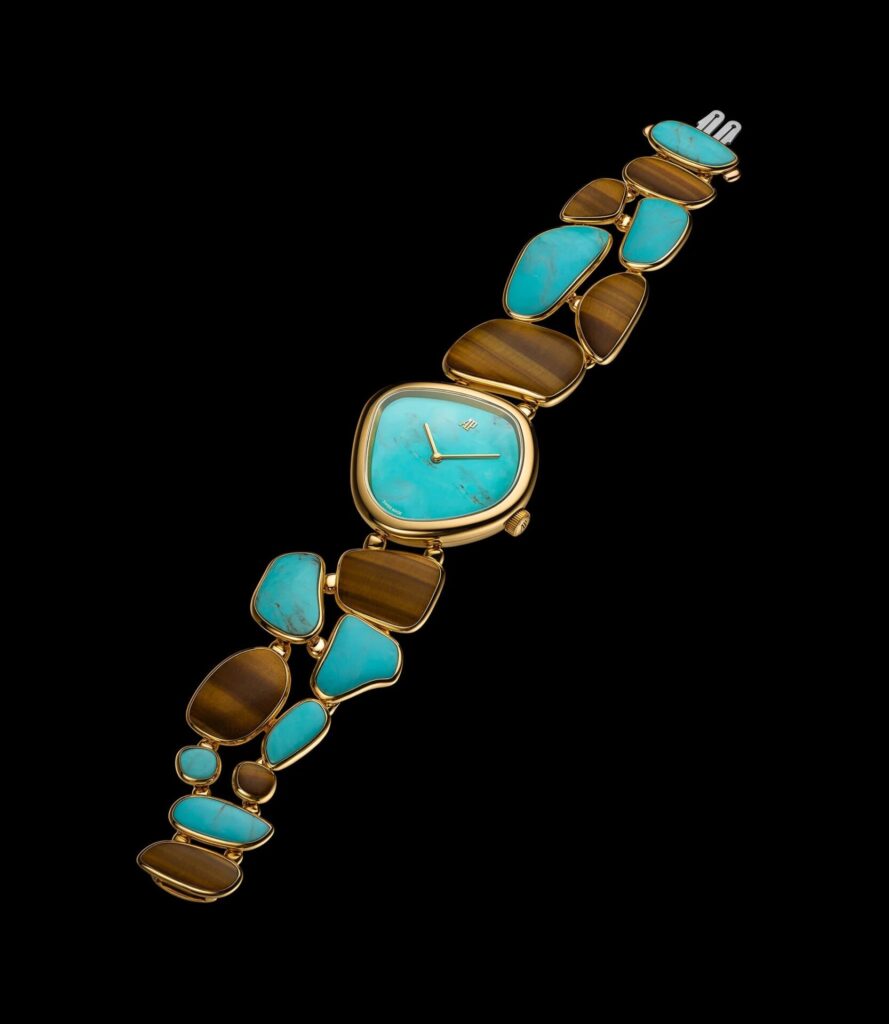
The Galets works because the concept is consistent all the way through. The pebble reference is not applied to the surface and left there. It runs through the bracelet construction, the bridge geometry, and the case shape. That level of internal coherence tends to be harder to achieve in a conventional product development process, where design and engineering often work at a distance from each other.
“This unique creation combines ancestral know-how with a poetic approach to materials. Born within the Atelier des Établisseurs, this creation embodies the uncompromising alliance between ancestral know-how, contemporary innovation, and artistic freedom that defines this creative space.”
Audemars Piguet
The Etablisseurs Peacock
Designer Kenan Geraud began the second watch with sketches around the idea of concealment, specifically watches that reveal the time rather than display it continuously. One sketch resembled a bird closely enough that the team suggested he take it further. The brand had produced watches shaped like animals in the 1990s, so the direction had precedent. The engineering, however, was a different matter. A bird with open wings on a wrist catches on clothing. The wings needed to open and close on demand. The time had to be legible when they were open. Watch developer Giulio Papi designed the opening mechanism, which draws more on automaton-making than conventional watchmaking.
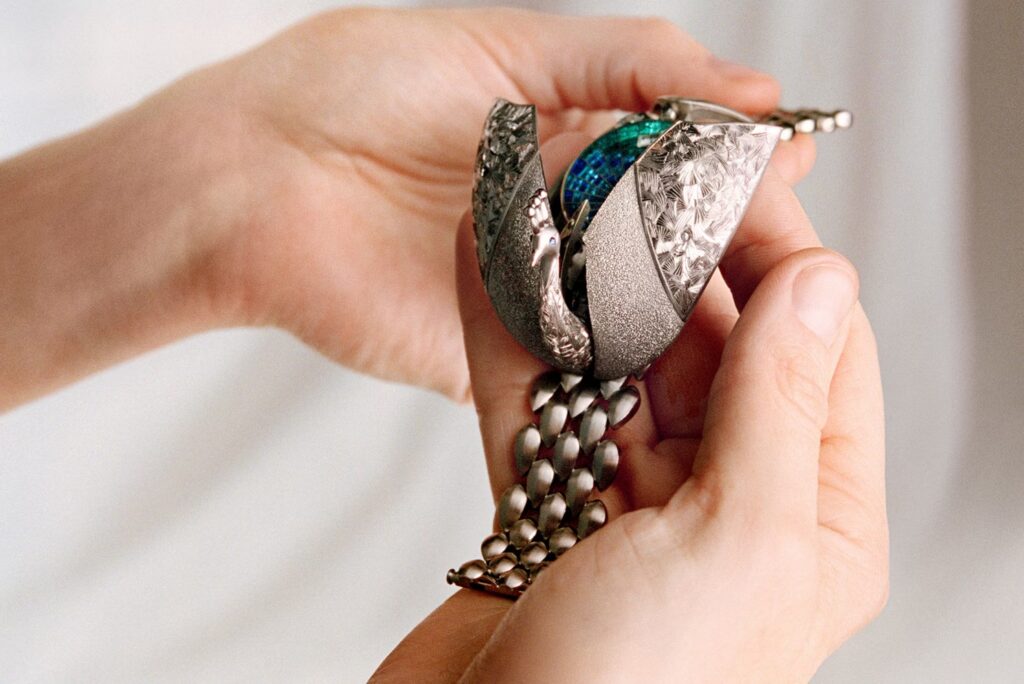
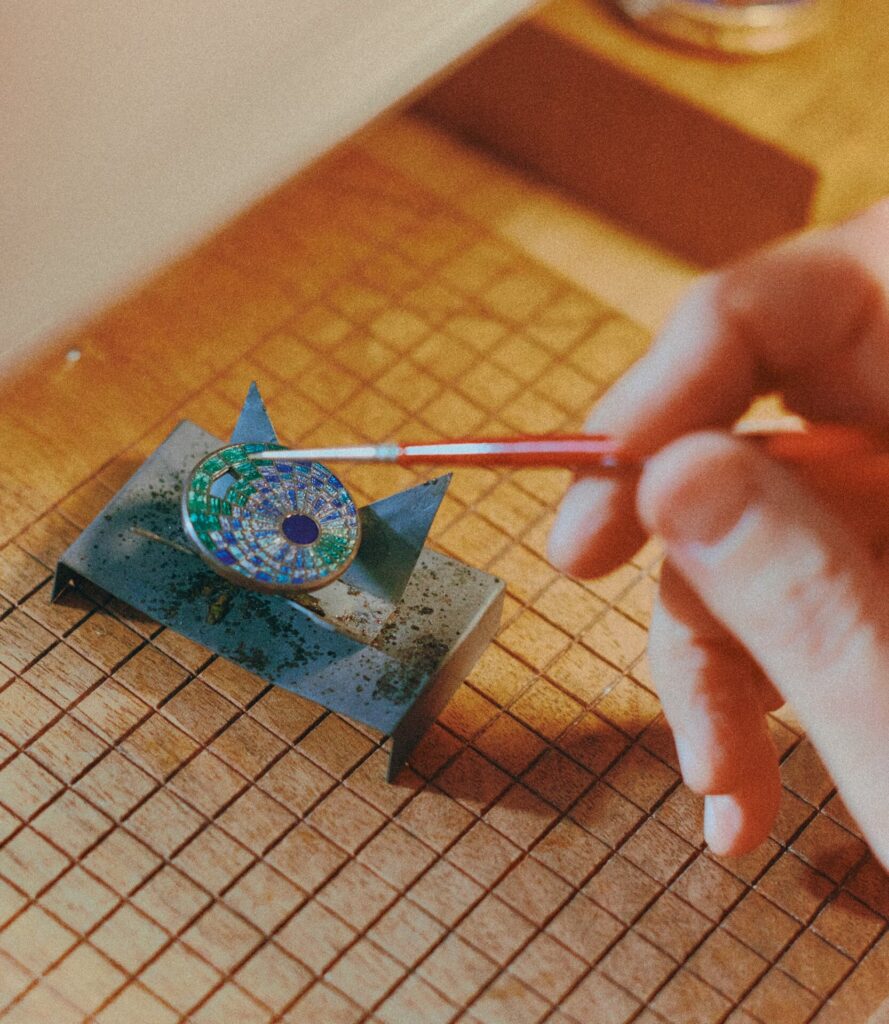
When Resta saw the concept in November 2024 she was unambiguous. If one particular watch must be made, this is the one. The gold dial was made by Vincent Michel of Saint-Imier and hand-engraved by Guy Froidevaux of La Chaux-de-Fonds. Enameller Vanessa Lecci applied translucent enamel in layers to each compartment of the dial from her Peseux workshop, giving the surface its depth of colour. Jeweller Ywan Kunzle, based at the Musee Atelier Audemars Piguet, made and assembled the bracelet by hand, with each link a shell and cover joined by invisible pins. The wings were cast by Adrian Altman’s workshops in Ipsach, then hammered and engraved.
“A tribute to the tradition of secret watches, the Établisseurs Peacock combines High Jewelry, the art of automata, and mechanical ingenuity in a unique miniature universe. Born from the Établisseurs workshop, this watch embodies the ancestral expertise, contemporary innovation, and artistic freedom that drive this creative space.” Audemars Piguet
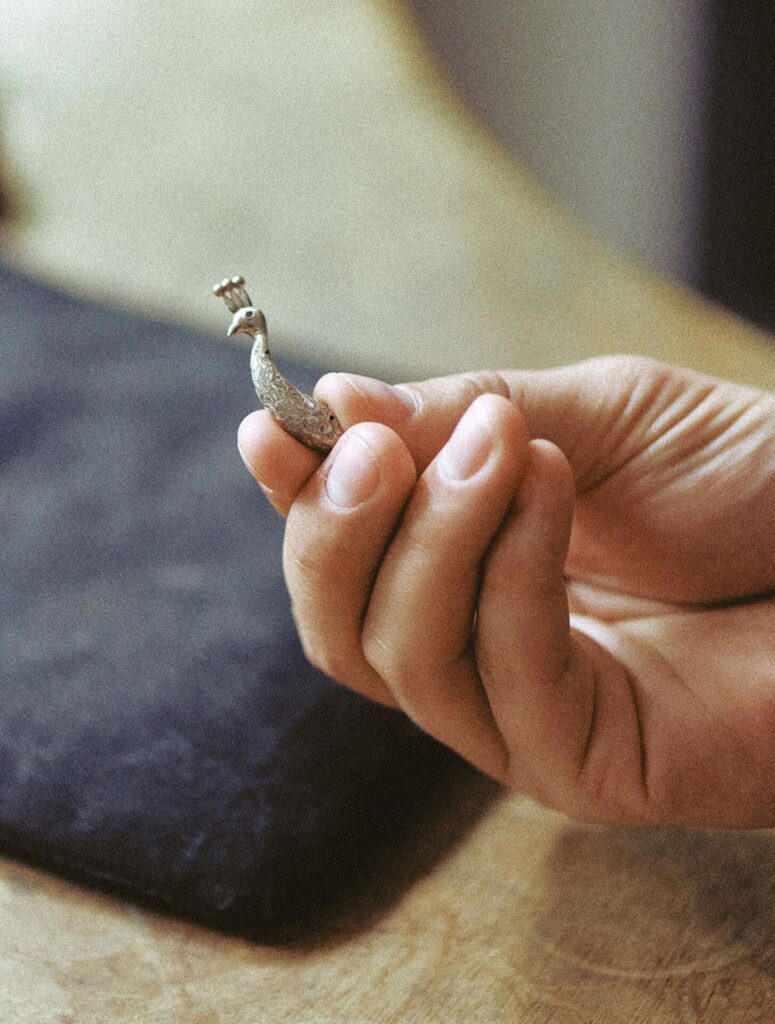
Closed, the watch sits low on the wrist, when opened, the head lifts and the wings open to show the time on the enamel dial. It runs on Calibre 3098, hand-assembled and hand-finished throughout.
The Etablisseurs Nomade
Ludovic Python built the third watch around transformation. Closed, the titanium and stone case fits into the small coin pocket on a pair of jeans. Two hidden pushers release it. Slide the case open and a skeletonised movement is visible, with its bridges positioned to read as hour markers. Pull it a little further and the case tilts up to stand on its own as a table clock. The sequence is precise and well-engineered, and the shift from one format to the other takes only a few seconds.
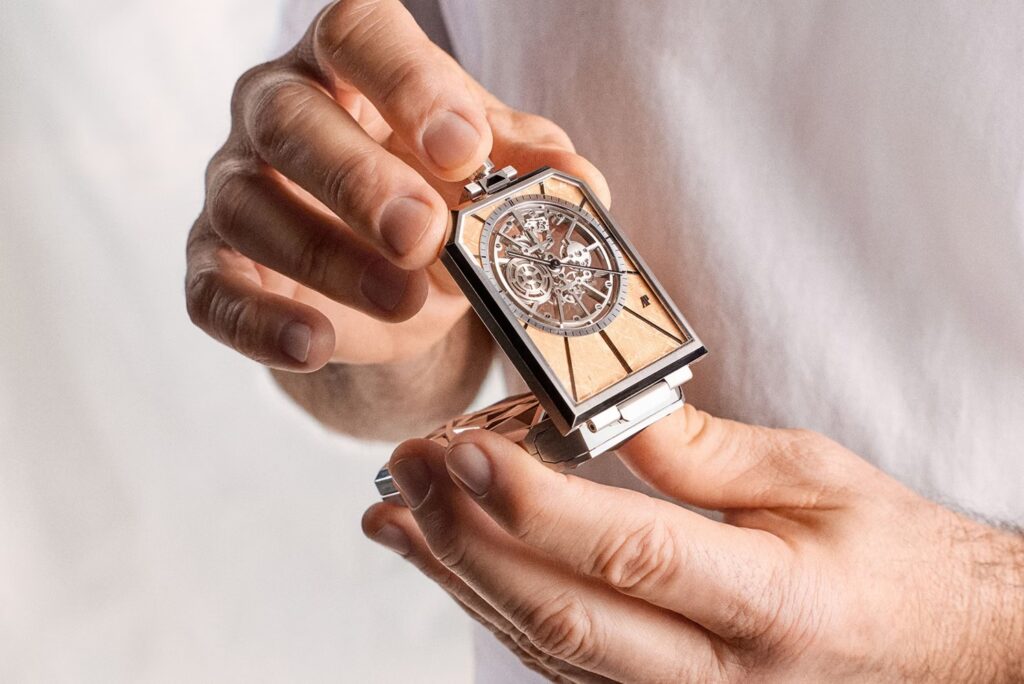
“L’Établisseurs Nomade offers a bold reinterpretation of historical handheld watches, through a sculptural and multifunctional design that effortlessly transforms from a pocket watch to a table clock. Born from the Établisseurs workshop, this piece embodies the uncompromising alliance between ancestral know-how, contemporary innovation, and artistic freedom that defines this creative space.” Audemars Piguet
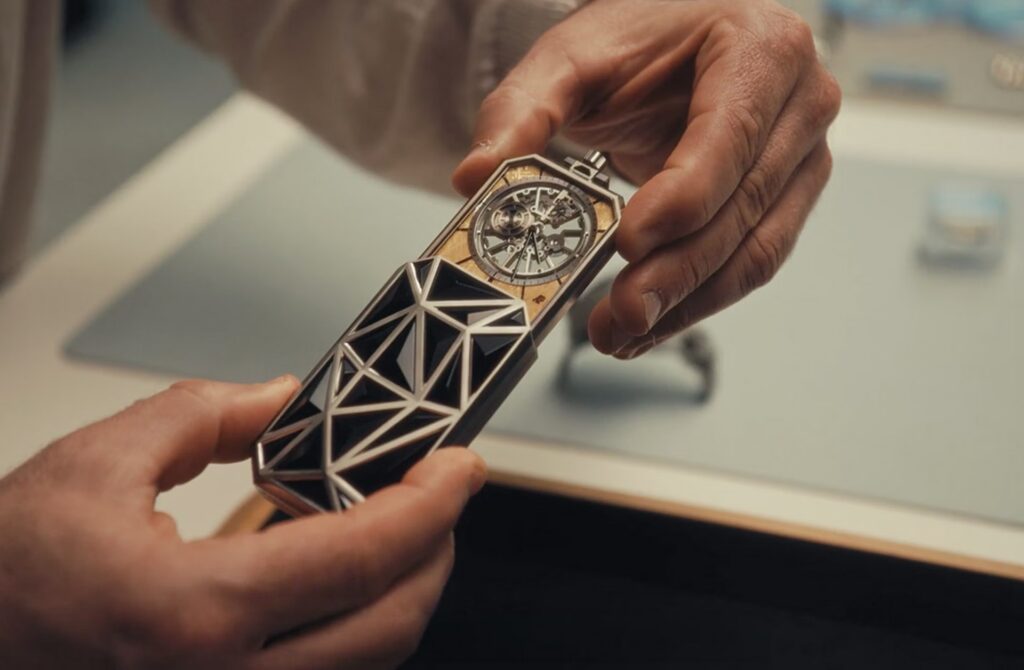
Calibre 7501 reworks the slim Calibre 7121 in a three-layer sandwich construction, secured by a rim Python designed for the piece. The skeletonisation was done by hand using a bocfil, a small jeweller’s saw that produces cleaner results than mechanical methods but requires considerable skill and time. Fewer workshops still offer it. The sliding and tilting mechanism was made by Emmanuel Desuzinges in Carouge. The sapphire crystal, produced by Alexis Bernard in Colombier, needed custom machining for its dimensions. The chain is titanium, which is rarely used in structures this geometrically complex. Production will run to around 15 pieces over several years.