


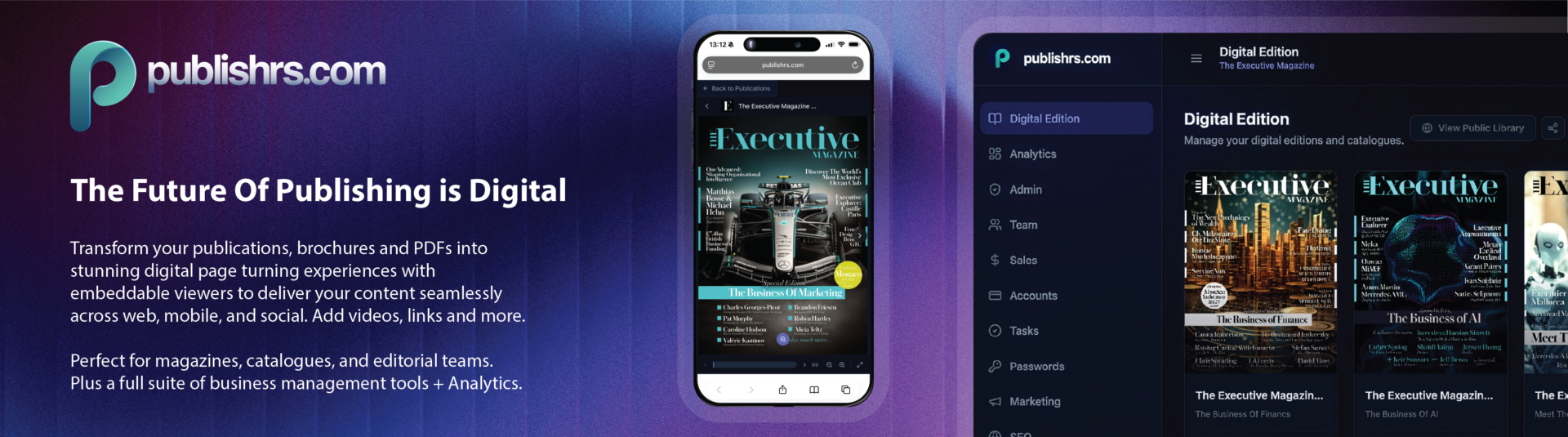
When a publication with over 480,000 subscribers and a reputation built on quality journalism decides to upgrade its digital publishing platform, the industry pays attention. The Executive Magazine, recognised as the UK’s leading title for luxury lifestyle and business news, has announced that Publishrs.com is now its platform of choice for digital edition publishing. It’s the kind of decision that reflects both where premium publishing is heading and what separates genuinely capable digital platforms from the rest of the field.
For publishers navigating the ongoing shift from print to digital, platform selection is one of the most consequential operational choices they’ll make. The wrong platform means frustrated readers, broken editorial workflows, and missed commercial opportunities. The right one does the opposite: it gives your content the environment it deserves and gives your team the tools they actually need. The Executive Magazine’s move to Publishrs is a clear statement about what good looks like in 2026.
In this article, we explore what drove the decision, what The Executive Magazine gains from the switch, and what it tells us about the direction premium publishers are taking with their digital strategies. Whether you publish a niche trade title or a large-circulation consumer magazine, there’s a great deal here worth understanding.
Why The Executive Magazine Needed a Digital Publishing Platform Built for Premium Content
Not all digital publishing platforms are designed with the same reader in mind. Some are built for speed and volume; others for commerce and conversion. The Executive Magazine’s readership is made up of senior business professionals and affluent lifestyle readers who expect something different. They expect an experience that matches the quality of the editorial itself.
The Premium Publisher’s Dilemma
Premium publications face a particular challenge when it comes to digital editions. Their print products are typically designed to the highest visual standards, with considered typography, high-quality photography, and a reading experience shaped over years of refinement. Translating that to digital has historically meant one of two compromises: either a static PDF that looks great but reads terribly on a phone, or a templated digital edition that sacrifices brand identity for responsiveness.
Neither compromise is acceptable for a title like The Executive Magazine. With 460,000 subscribers accustomed to a certain standard, the gap between a print and digital experience is felt immediately.
Publishrs addresses this directly. The platform is built to honour a publication’s visual identity whilst delivering the responsiveness and interactivity modern readers expect. For The Executive Magazine, that meant retaining its distinctive editorial aesthetic across every device its readers use, whether that’s a desktop in a boardroom or a smartphone in a departure lounge.
Publishrs’ design and layout tools give editorial teams genuine control over how their content appears in digital editions, without requiring technical expertise or lengthy production cycles. It’s one of the clearest ways the platform differentiates itself from generic content management systems that treat every publication the same.
What premium publishers need from a digital platform:
- Brand-faithful design that carries the publication’s visual identity across all screen sizes
- Mobile-first rendering that doesn’t force readers to pinch and zoom through pages
- Support for rich media and interactive content without complicating editorial workflows
- Subscriber delivery infrastructure that integrates with existing circulation management
- Analytics that provide commercially useful audience data, not just page views
The Executive Magazine’s selection of Publishrs suggests it found all of the above in one place, which in a crowded platform market is harder to achieve than it sounds.
What The Executive Magazine Gains from Publishrs’ Digital Magazine Platform
A platform partnership isn’t just about fixing what was broken. For The Executive Magazine, the move to Publishrs represents a step forward in several areas simultaneously: reader experience, editorial efficiency, and commercial capability. Each of those gains is meaningful on its own; together, they represent a significant operational upgrade.
Reader Experience and Subscriber Retention
Subscriber retention in digital publishing is directly tied to reading experience. According to research from the Reuters Institute for the Study of Journalism, reader satisfaction with digital editions is closely linked to ease of use, speed of loading, and how well content is adapted for mobile screens. Publications that offer poorly optimised digital editions consistently see higher churn rates among digital subscribers.
Publishrs’ mobile-first architecture means that The Executive Magazine’s digital edition now loads quickly, reads cleanly, and renders correctly across the full range of devices its subscribers use. That’s not a minor improvement. For a title with hundreds of thousands of subscribers, even a modest reduction in churn driven by a better reading experience translates into meaningful revenue retention over time.
Editorial Workflow and Production Efficiency
Beyond the reader-facing improvements, the switch also delivers real gains for The Executive Magazine’s editorial and production teams. Legacy publishing workflows often involve multiple conversion steps between print and digital editions, processes that consume time, introduce errors, and create friction between the editorial and production departments.
Publishrs reduces that friction considerably. The platform’s production tools are designed around how magazine teams actually work: issue-based publishing cycles, collaborative editorial sign-off, and the ability to publish updates to live editions without disrupting the reader experience. Publishrs’ editorial workflow features allow teams to manage digital production without adding headcount or extending deadlines.
For a publication like The Executive Magazine, which publishes regularly and maintains high production standards, that efficiency is commercially important. Faster digital production means more time focused on journalism and content quality, which is, after all, what subscribers are paying for.
Premium Publishers and the Digital Magazine Platform Market
The Executive Magazine’s decision doesn’t exist in isolation. It reflects a wider pattern playing out across the publishing industry, as established titles reassess the platforms underpinning their digital businesses. The digital magazine platform market is growing rapidly, projected to expand from $1.11 billion in 2026 to over $2 billion by 2032, and publishers are under real pressure to ensure they’re on the right infrastructure before that growth accelerates further.
Why Platform Choice Has Become a Strategic Decision
Until relatively recently, many publishers treated their digital edition platform as a back-office technical matter. The print product was the business; the digital edition was an add-on. That thinking has been overtaken by events. Digital subscriptions now represent the primary or secondary revenue stream for a significant proportion of established magazine publishers, and the platform delivering those subscriptions has become central to commercial strategy.
The implications are significant. A platform that limits what you can charge, restricts how you engage with subscribers, or provides inadequate data about reading behaviour isn’t just a technical inconvenience. It’s a direct constraint on revenue growth. Publishers who made platform decisions five or six years ago on the basis of cost or ease of setup are now discovering that those decisions have real commercial consequences.
This is precisely the kind of strategic reassessment that leads publications like The Executive Magazine to make a change. When the platform is limiting growth rather than enabling it, the cost of switching is outweighed by the cost of staying put.
Platform Capability Comparison
Platform Capability Legacy PDF Solutions Publishrs.com Mobile-optimised rendering Limited / manual Automatic, responsive Subscriber analytics Basic page views Granular engagement data Editorial workflow integration Minimal Built-in, issue-based Brand design fidelity PDF only Full design control Interactive content support None Native multimedia Subscriber delivery infrastructure Basic email Multi-channel delivery
What’s driving the market shift:
- Reader expectations for mobile-first content have moved well ahead of what PDF-based platforms can deliver
- Commercial teams need audience data that static digital editions simply cannot provide
- Editorial teams are under pressure to reduce production time without cutting corners on quality
- Subscriber acquisition costs have risen, making retention and engagement more commercially critical than ever
Audience Data and Commercial Capability: A New Advantage for The Executive Magazine
One of the less-discussed but commercially significant benefits of a modern digital publishing platform is what it tells you about your readers. Print journalism has always had a fundamental blind spot: publishers knew their circulation figures but had relatively little insight into which content their readers actually engaged with. Digital publishing changes that entirely, but only if the platform you’re using is built to capture and surface that data.
From Circulation to Engagement Intelligence
Publishrs gives The Executive Magazine access to the kind of audience intelligence that changes how a commercial team talks to advertisers and sponsors. Rather than presenting circulation numbers and readership estimates, the magazine’s team can now discuss specific engagement metrics: which features generate the most reading time, which sections drive the highest return rate, and which formats perform best with different audience segments.
For advertisers, that shift in the conversation is valuable. Brands placing advertising or sponsorship in The Executive Magazine can now be shown real engagement data rather than modelled estimates. That’s a meaningful commercial differentiator in a market where advertisers are increasingly demanding proof of performance.
Publishrs’ audience analytics tools are built specifically for publishing teams, not generic data analysts. The dashboards surface the metrics that matter to editors, publishers, and commercial directors, without requiring a dedicated data team to interpret them.
Supporting Sponsored Content and Native Advertising
The Executive Magazine’s content mix includes high-value sponsored features and native advertising alongside its editorial coverage. Managing that content effectively within a digital edition requires a platform that can handle different content types, maintain appropriate labelling, and provide performance reporting that satisfies both the editorial team’s standards and the advertiser’s expectations.
Publishrs handles this natively. The platform supports the full range of commercial content formats used by premium publishers, with the workflow tools to manage them efficiently and the reporting infrastructure to demonstrate their performance. For The Executive Magazine’s commercial team, that’s a genuine operational advantage over what most comparable platforms offer.
Digital Publishing Platform Selection: What Other Publishers Can Learn from This
If you’re a publisher watching The Executive Magazine’s decision and wondering whether your own digital platform is still fit for purpose, you’re asking the right question. Platform evaluation is something many publishing businesses put off because it feels complex, disruptive, and expensive. In practice, staying on the wrong platform is often all three of those things, just spread out over a longer period and with less visibility.
Signs Your Current Platform May Be Holding You Back
There are several indicators that a digital magazine platform has passed its peak usefulness for your business. If your editorial team routinely complains about production friction, if your subscriber analytics feel thin or hard to act on, if your digital edition looks noticeably worse on mobile than on desktop, or if your commercial team struggles to demonstrate digital audience value to advertisers, any one of these is worth taking seriously.
The cumulative effect of a platform that doesn’t serve your business well is often hard to quantify until you’ve switched and can see the difference. The Executive Magazine’s move to Publishrs is instructive in that regard: it’s not a response to a crisis, but a proactive decision to get onto better infrastructure before limitations become problems.
Publishers considering a similar evaluation would do well to look at Publishrs’ case studies to understand the range of publications the platform serves and the specific outcomes it has delivered.
Making the Case Internally for a Platform Switch
One of the practical challenges in platform migration is building internal consensus. Editorial teams worry about workflow disruption; technical teams worry about integration complexity; finance teams worry about cost. All of those concerns are legitimate, and a well-run migration should address each of them directly.
A practical internal checklist for platform evaluation:
- Audit your current platform’s performance against subscriber retention, engagement metrics, and editorial team satisfaction
- Quantify the commercial impact of current platform limitations, specifically around advertiser reporting and audience data
- Request a detailed migration timeline and support commitment from prospective new platforms
- Assess integration requirements with your existing CMS, subscription management system, and circulation infrastructure
- Evaluate the ongoing support model, not just the onboarding process
- Consider total cost of ownership, not just licence fees. Include production time savings and subscriber retention improvements in the calculation
Publishrs is designed to make this evaluation straightforward. The platform’s onboarding process is built around minimising disruption, and the team works directly with publishers to ensure the transition doesn’t interrupt editorial cycles or subscriber experience during migration.
What This Partnership Means for the Future of Premium Digital Publishing
The Executive Magazine’s decision to choose Publishrs as its digital publishing platform is significant beyond the two organisations involved. It’s a signal about where the premium publishing market is moving and what publishers at that end of the market expect from their technology partners.
Quality and Capability Are Converging
For a long time, there was an implicit trade-off in digital publishing platforms. You could have a platform that was easy to use, or one that produced high-quality output, or one that provided strong commercial infrastructure, but rarely all three at once. The platforms that addressed one dimension well typically fell short in another.
The growing adoption of purpose-built platforms like Publishrs reflects the fact that this trade-off is no longer necessary. Publishers of The Executive Magazine’s calibre are finding that they can have editorial quality, operational efficiency, and commercial capability from a single platform, and they’re making the switch accordingly.
For publishers who haven’t yet made that assessment, the trajectory is clear. As noted by What’s New in Publishing, the industry is in the middle of a sustained period of digital infrastructure investment, driven by the recognition that sustainable digital publishing requires platforms built specifically for the task. Generic CMS solutions and PDF-based digital editions are increasingly inadequate for publishers with serious growth ambitions.
The Executive Magazine is a case in point. Its move to Publishrs positions the title to grow its digital subscriber base, strengthen its commercial proposition, and maintain the editorial standards its readership expects, all from a single, purpose-built platform. That combination is hard to argue with, and it’s why more premium publishers are following a similar path.
A Clear Direction for Premium Digital Publishing
The Executive Magazine’s choice of Publishrs as its digital publishing platform is more than a vendor announcement. It’s a clear signal about what premium publishers require from their digital infrastructure in 2026 and beyond. A strong digital edition needs to honour the editorial quality of the content it carries, work well across every device readers use, and give commercial teams the data they need to build a sustainable advertising business alongside digital subscriptions.
Publishrs delivers on all three. Its growing client base among established, quality-focused publications reflects a platform that understands the publishing business, not just the technology. For publishers still assessing their options, The Executive Magazine’s decision is worth taking seriously.