


Unitree Robotics finished its first session on the Shanghai Stock Exchange 460% above its offer price, an outcome that rewarded the retail accounts that queued for stock and did something more durable besides. The humanoid robot industry now has a daily quotation attached to a company that designs, manufactures and sells the machines in volume.
Until recently, valuations across the sector were set privately, negotiated between founders and venture backers, and revealed only when a funding round closed. A listed pure play changes the arithmetic for everyone building in the category, because every subsequent prospectus, private mark and internal robotics programme now has a live comparator to be measured against.
The debut landed on the opening day of the World Robot Conference in Beijing, the second major listing in a month to test appetite for Chinese hardware after memory chipmaker CXMT surged 466% on its own first day of trading.
The market sets a price
The Hangzhou company sold 40.45 million new shares at 150.80 yuan each, a little over £16.50, raising roughly 6.1 billion yuan, or about £670 million, and placing close to a tenth of the business in public hands. Because the shares were newly issued, the proceeds went to the company rather than to existing owners taking money off the table. Retail demand ran more than 8,000 times the available stock, a record for the tech-focused STAR market.

Trading opened at as much as 629% above the offer, touching 1,100 yuan, or roughly £120 a share, before settling at 845 yuan by the close. That valued the business at around £37 billion, against about £6.7 billion at the offer price. DeepSeek put some 140.8 million yuan, close to £15 million, into the deal, joining Tencent among the names on the register.
Profitable Hardware
What separates the company from most of its peer group is a profit and loss account that works. Revenue reached about 1.7 billion yuan in 2025, roughly £186 million and an increase of around 335% on the prior year, with gross margins near 60% and the humanoid line running at close to 62.9%. Most developers in the field are still absorbing heavy research and deployment costs.
Humanoids accounted for 1.9% of revenue in 2023 and 51.5% across the first nine months of 2025, overtaking the four-legged machines that built the company’s name. More than 5,500 humanoid units shipped last year, while the average selling price fell from about 593,400 yuan in 2023, some £65,000, to 167,600 yuan in 2025, around £18,400. Falling prices alongside improving margins is the signature of a manufacturing cost curve working properly.
An Open platform
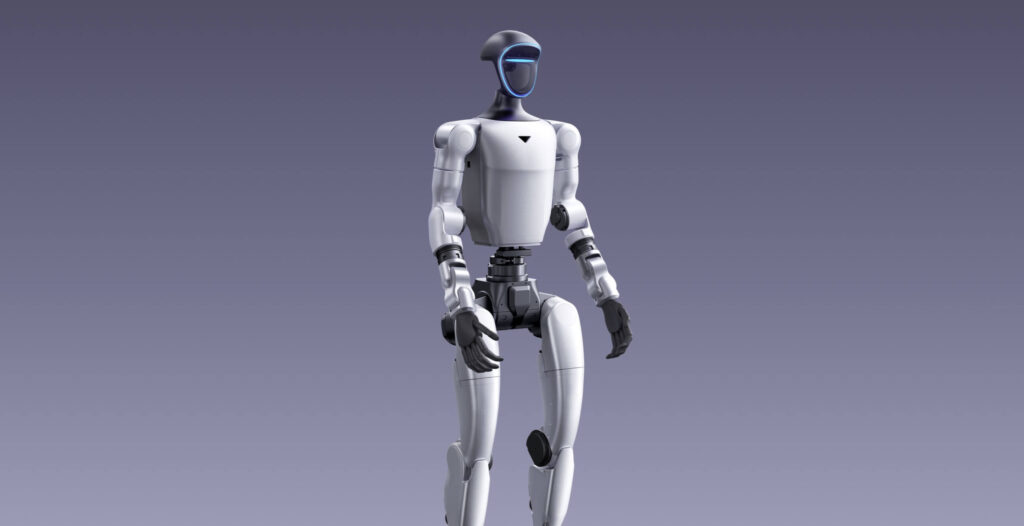
The product range covers bipedal humanoids that walk and manipulate objects with dexterous hands, alongside quadrupeds used for tasks such as hazard detection. Two days before the listing, the company unveiled a humanoid called Superman, which it says can jump two metres from a standing position and run at up to 12.66 metres per second.
Customers extend well past Chinese academia. Renjie Guo, founder and chief executive of robotics engineering company Zeroth, said the machines are in use at American technology groups including Nvidia, Google and Amazon. “It has formed the underlying ecosystem that enables many people to build their developments on top of Unitree,” he said. That position matters, because platform economics tend to compound long after the hardware margin has normalised.
Capital deployed
Proceeds are earmarked for research into robot models and control systems, hardware development, new product lines and a dedicated manufacturing base, with an ambition to reach annual production capacity of 190,000 robots. Founded in 2016 by Wang Xingxing with 100,000 yuan of registered capital, a little under £11,000, the company has moved from a quadruped specialist to the largest humanoid maker by unit sales in under a decade.
Overseas sales have consistently accounted for more than 40% of revenue, which gives the capacity expansion a wider market to serve than the domestic one alone. Reliable performance at industrial scale remains the sector’s outstanding question, and the capital raised is aimed squarely at answering it.
A Steepening curve
Morgan Stanley lifted its forecast for Chinese humanoid shipments in June to 50,000 units this year, close to double its earlier projection of 28,000. The bank expects the domestic market to grow from about £1.5 billion this year to some £11 billion by 2030.
The bank also anticipates pilot projects moving into broader deployment during the second half of this year, with full-size humanoids accounting for roughly 30% of shipments now and around 70% by 2028. Most machines sold to date have gone into research, education and demonstration work. A profitable manufacturer with a public share price, a falling unit cost and a developer base already building on its platform is well placed as that balance moves towards commercial use.