


The modern executive faces an unprecedented challenge: maintaining operational excellence whilst driving transformational change across increasingly complex global markets. At Bayes Business School, positioned strategically between London’s financial district and its thriving technology ecosystem, a new model of executive education has emerged that directly addresses this paradox.

Harry Young’s journey exemplifies this transformation. When the chartered accountant enrolled on the Modular Executive MBA programme in 2022, he held the position of Group Financial Controller at creative agency Squint/Opera. Today, as Global Finance Director at Journey, a design and innovation consultancy, his trajectory illustrates how the programme catalyses both personal advancement and organisational growth. His story reveals how contemporary business education, when properly structured, becomes a catalyst for immediate commercial impact rather than merely academic achievement.
The evolution of executive business education
Traditional business education often struggled to bridge the gap between theoretical frameworks and practical application. At Bayes, this disconnect has been systematically addressed through what Professor Costas Andriopoulos, Associate Dean of MBA Programmes, describes as a fundamental reimagining of curriculum design. The school has moved decisively away from examination-based assessment towards experiential learning that mirrors boardroom decision-making.

The Executive MBA programme now incorporates live consulting projects, international field experiences, and cross-disciplinary modules that prepare leaders for the complexities of modern business. This approach proved particularly valuable for Young, who immediately applied classroom insights to his organisation’s expansion strategy. From the programme’s first days, he focused on identifying leverage points that would deliver maximum impact for both his finance function and the broader business.
Flexibility that acknowledges professional realities
Senior executives considering advanced education face a fundamental tension: the desire for professional development competing with demanding careers and personal commitments. The institution has developed three distinct delivery formats, each spanning two years, to accommodate varying professional circumstances.
The Evening Executive MBA suits London-based professionals through twice-weekly evening sessions. The Modular Executive MBA, which Young selected, combines monthly long weekends with supplementary online learning. The Global MBA delivers content primarily online with strategic campus residencies. This structural flexibility enables executives to maintain career momentum whilst pursuing transformational education.
Young’s experience illuminates this balance. As a new father with a six-month-old daughter when he began the programme, whilst simultaneously navigating his company’s sale to a private equity-backed business, he discovered that success required strategic integration rather than compartmentalisation. His solution involved making MBA assignments directly applicable to business challenges, requesting relevant data from colleagues and using real commercial situations as assignment foundations.
Strategic application drives commercial results
The programme’s emphasis on immediate application distinguishes it from traditional academic approaches. Two modules particularly influenced Young’s professional trajectory: Corporate Strategy and The New Strategic Landscape elective. However, the Mergers & Acquisitions elective, taught by Professor Scott Moeller, Director of the M&A Research Centre, proved transformational.
Young’s Business Project focused on M&A best practices for targeting searches among small to medium-sized businesses, coinciding perfectly with his company’s acquisition ambitions. The project’s development involved extensive stakeholder engagement, including interviews with founders, private equity owners, and senior executives across the portfolio. This approach ensured both academic rigour and commercial relevance, with recommendations that secured immediate buy-in from decision-makers.
The organisation had already witnessed value from Young’s ongoing studies, making leadership receptive to his strategic recommendations. His systematic approach to knowledge transfer meant that MBA insights consistently informed business decisions, creating a virtuous cycle where academic learning directly enhanced commercial performance.
Technology and human leadership converge
Contemporary business leadership demands fluency in artificial intelligence and digital transformation whilst maintaining distinctly human elements of strategic judgement. Through the Bayes X Research Centre, the programme integrates cutting-edge innovation insights directly into classroom experiences. Students explore AI not as abstract technology but as leadership challenges requiring ethical frameworks and cultural sensitivity.
The curriculum balances technological sophistication with emphasis on curiosity, critical thinking, and organisational culture. Environmental, Social and Governance considerations permeate the programme rather than being confined to standalone modules. Students learn to build governance structures, redesign supply chains, and engage stakeholders in ways that deliver both purpose and performance.
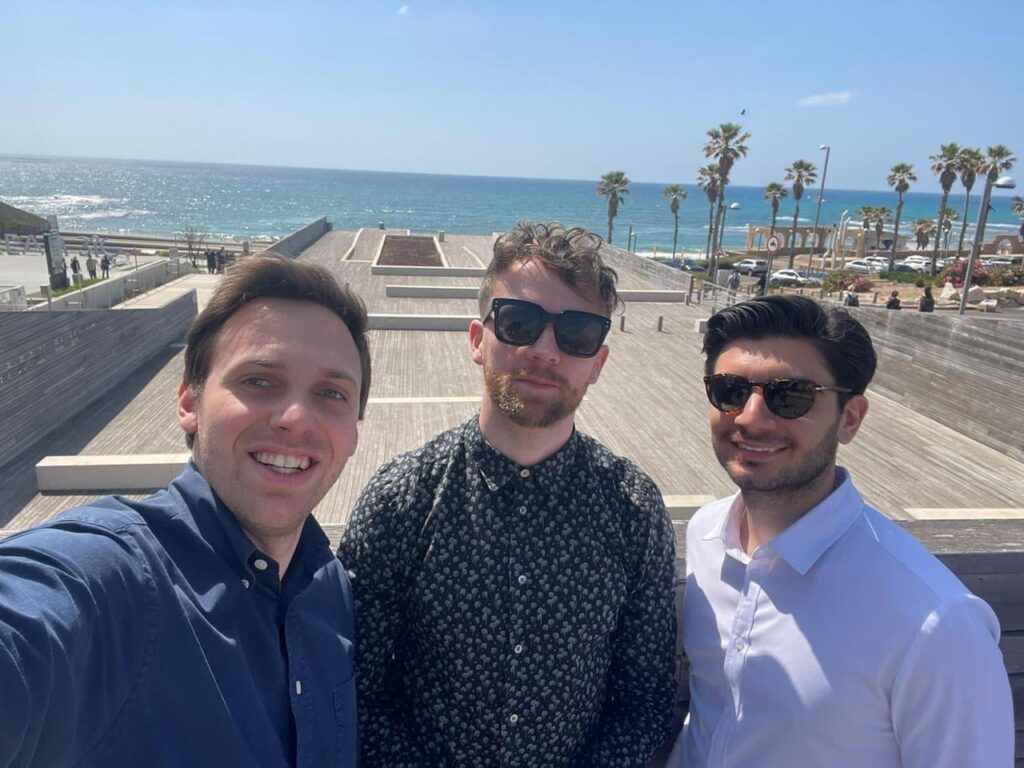
Young’s international electives further broadened his strategic perspective. The Innovation and Technology Study tour to Israel and Palestine provided unexpected insights into ecosystem development and talent concentration. Visiting Tel Aviv, Jerusalem, and Ramallah revealed how geographic clustering of similar businesses accelerates economic growth, insights he immediately connected to London’s creative agency landscape.
Career transformation through continuous learning
The programme’s approach to career development transcends traditional placement services. Bayes has pioneered credit-bearing career management modules within core curriculum, recognising that leadership development requires deliberate cultivation alongside technical competencies. The redesigned Career Impact Module incorporates strategic career management, leadership development, and advanced communication skills.
Young’s progression from Group Financial Controller to Global Finance Director at Journey demonstrates the programme’s transformational potential. His expanded remit now encompasses not just financial oversight but strategic leadership across a design and innovation consultancy with global ambitions. The MBA broadened his worldview, developing his ability to evaluate multiple perspectives and approach challenges with enhanced analytical sophistication.
This transformation extends beyond individual advancement. Young articulates a clear vision for his organisation’s future: recognition as a global leader over a ten-year journey. The programme instilled drive that transcends mere sufficiency, fostering ambition for meaningful achievement and lasting commercial impact.
London’s unique ecosystem advantage
The school’s location provides unparalleled access to both established financial institutions and emerging technology ventures. Students experience what the institution terms the London Symposium, a flagship module offering direct engagement with organisations spanning agile start-ups to global multinationals. These interactions traverse sectors from media and entertainment to artificial intelligence, providing exposure to diverse business models and collaborative ecosystems.
This geographic advantage translates into tangible benefits through alumni networks exceeding 50,000 professionals worldwide. Current students access mentorship, speaking engagements, and project partnerships with those who have navigated similar professional journeys. Corporate partners and honorary visiting faculty contribute real-time market knowledge, ensuring curriculum relevance amidst rapid industry evolution.
The deliberately diverse cohorts, drawing professionals from varied sectors and geographies, create powerful peer learning environments. Executives develop cultural intelligence and global mindsets through exposure to different leadership approaches and business contexts, preparing them for increasingly international commercial landscapes.
The future of executive development
Bayes demonstrates commitment to lifelong learning through innovative alumni benefits. Graduates receive one complimentary elective annually for life, alongside continued access to career resources and professional development content. This approach acknowledges that leadership development requires continuous evolution rather than discrete educational episodes.
The institution’s vision extends beyond traditional degree provision towards partnership in ongoing professional growth. As business complexity accelerates and technological disruption intensifies, this model of continuous engagement becomes increasingly vital for maintaining leadership effectiveness.
Young’s advice to prospective students emphasises strategic focus: breaking challenges into manageable components, maintaining physical and mental wellbeing during intensive study periods, and attacking assignments immediately after teaching weekends. His experience confirms that successful Executive MBA completion requires not just intellectual capability but systematic approach and sustained commitment.