


High jewellery has always been a test of what human hands can achieve, and machines have begun to pass versions of that test in unexpected ways. Algorithms can now sketch a setting, model its proportions and suggest a palette before a workshop cuts a single stone. Boucheron’s answer is the Human Being collection, its newest high jewellery work, which argues for the irreplaceable value of the human hand through five sets of pieces that no machine could currently make.
Creative director Claire Choisne, a jeweller by training, structured the collection around the cluster necklace, a form that gathers different stones into a single composition. The theme, the house explains, is the balance between the similarities that draw people together and the differences that make each person unique. Every set pairs a necklace with a ring, giving collectors ten pieces that read as one continuous study of identity.
The timing is pointed. As artificial intelligence spreads through design studios and workshops, the maison has chosen to celebrate techniques that depend on judgement, patience and touch rather than processing power. The result is a collection that functions as quietly as it sparkles, and one that rewards the closest possible inspection.
Craft in the age of the machine
Machines have earned a place in modern jewellery making, from laser cutting to computer modelling, and Boucheron uses them where they help. Human Being draws its character from what lies beyond them. The house frames each piece as an exercise in looking closer, built around “details that define who we are” that only reveal themselves under magnification.

Choisne selected the cluster necklace as the collection’s guiding form precisely because it cannot be reduced to a formula. Different stones, different cuts and different treatments must hold together as one composition, which places the burden on the artisan rather than the software. Her own training as a jeweller sits behind every decision in the five sets, each of which demands a technique the others do not use.
Five studies in stone
Rain and Flower: diamonds and painted petals
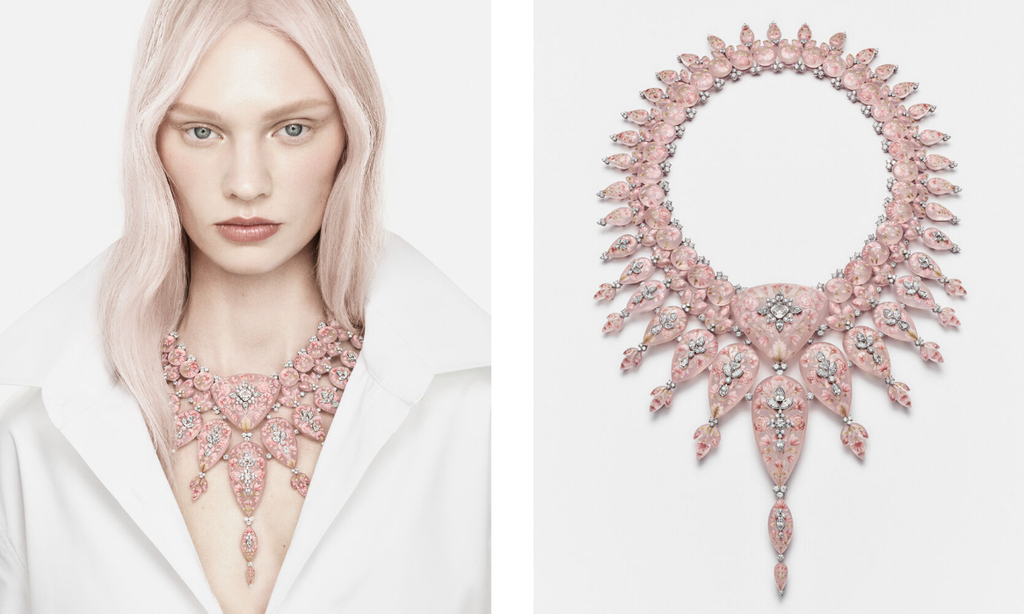
The Rain set creates the illusion of diamonds dripping down the skin like water. Artisans shaped hollow droplets from rock crystal, whose transparency leaves the stones appearing suspended in space, then placed 4,800 diamonds between coats of plant-based resin before sealing each one. The pieces join along an articulated spine of white gold, itself set with diamonds, and the sequence took 1,300 hours to complete.
Flower takes a gentler route to a similar sense of wonder. Micro-miniature painters worked under magnification to hand-paint botanical motifs across 1,532 carats of rose quartz, capturing light and shadow in microscopic depth before a matte varnish sealed each surface. Each stage of a bloom’s unfurling, from bud to full petal, appears across the necklace, which centres on a 3.26-carat cushion-cut diamond framed in pink gold, white gold and platinum. Each quartz panel is pierced and mounted on hidden pin work so that no visible prong interrupts the surface.
Light and Tattoo: soft stones and ancient carving
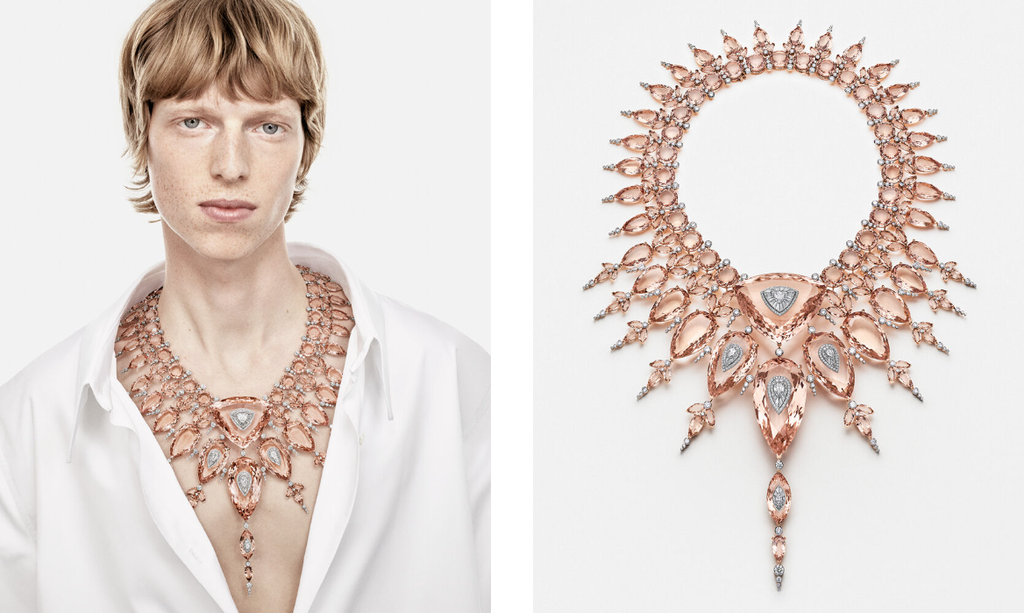
The Light set rests on morganite, a gem soft enough at 7.5 to 8 on the Mohs scale that traditional hammering would risk damaging it. Boucheron’s bench jewellers instead fitted and screwed rose gold prongs around each stone by hand, after matching more than 1,500 carats of morganite for uniform colour and hollowing some pieces from within. The ring carries 174 carats of morganite alongside a 0.72-carat pear-cut diamond, with sapphire glass moderating the light between them.
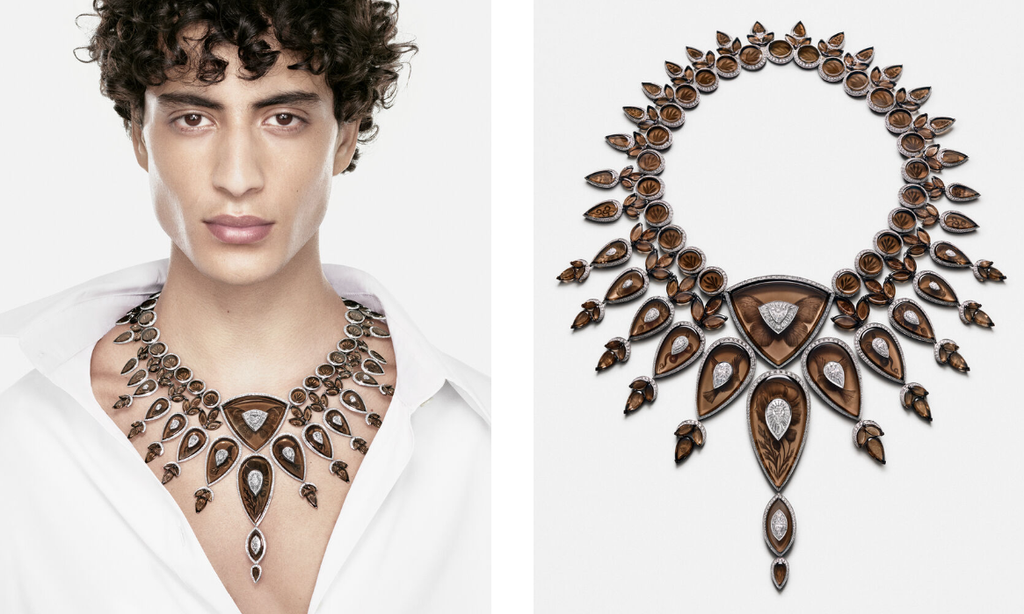
Tattoo reaches further back, reviving glyptic art, the ancient carving technique behind cameos and intaglios, to work 580 carats of smoky quartz in bas-relief. A single gem carver shaped each panel from the reverse side, varying depth, relief and texture so that poppies, roses, chickadees, cicadas, snakes, butterflies and foliage drawn from the house archive appear to sit on the skin like Victorian tattoos. The undertaking required the maison to invent more than 200 specialised tools as the hard quartz wore each one down. The necklace centres on a 1.74-carat troidia-cut diamond.
Checkers: laser precision, hand finished
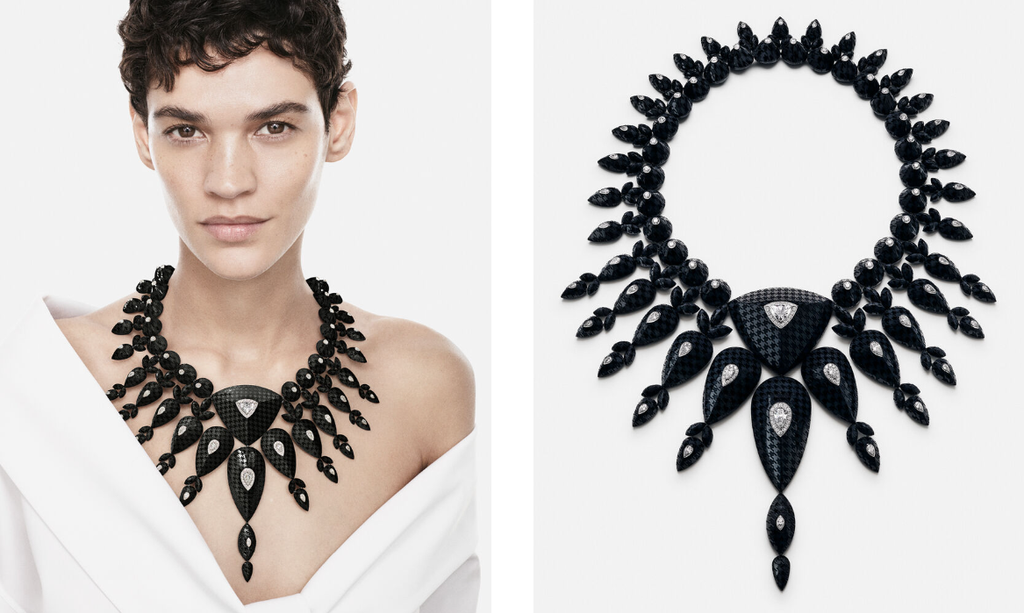
The Checkers set borrows a technique from watchmaking instead. A femtosecond laser engraved a houndstooth pattern into 163 pieces of onyx, removing material without heat so that the black stone keeps its depth. The pattern is meant to be touched as much as seen, echoing the tactile quality of a woven textile that Choisne admires.
No single setting could serve twice, so the workshop produced 163 unique calibres, one for each stone, while extensive modelling kept the pattern flowing unbroken across the necklace. Six central onyx panels were hollowed out to lighten the piece at the throat. The ring finishes the set in white gold and titanium with a 0.71-carat pear-cut diamond.
Why the hand still matters
Boucheron has more reason than most to defend patient handwork. Founded by Frédéric Boucheron in 1858, it became the first jewellery house to settle on Place Vendôme, and its archives still feed modern pieces such as the Tattoo set. Human Being extends that lineage into a moment when machines draft, cut and grade with growing independence, drawing a boundary around what remains stubbornly human.
The five sets are offered on a price-on-request basis, as is customary in high jewellery, and each answers a question that buyers increasingly ask of luxury objects: who made this, and how? The collection’s arguments sit in its resin-sealed raindrops, its hand-painted quartz and its houndstooth pattern flowing across dozens of separate onyx stones as though it were one piece of cloth. In that sense it is less a rejection of technology than a reminder of what technology is for, and what it still cannot do.