


When MB&F opened a gallery in Geneva in 2011, the concept had no precedent. Kinetic horological machines sat uncomfortably in traditional watch boutiques, and the art world was not ready to call them sculptures. The solution was to build something entirely new. Fifteen years on, the M.A.D.Gallery has grown from a single experiment into an international network and a cultural fixture for collectors and artists, marking the anniversary with a limited-edition collaboration that captures everything the project was built upon.
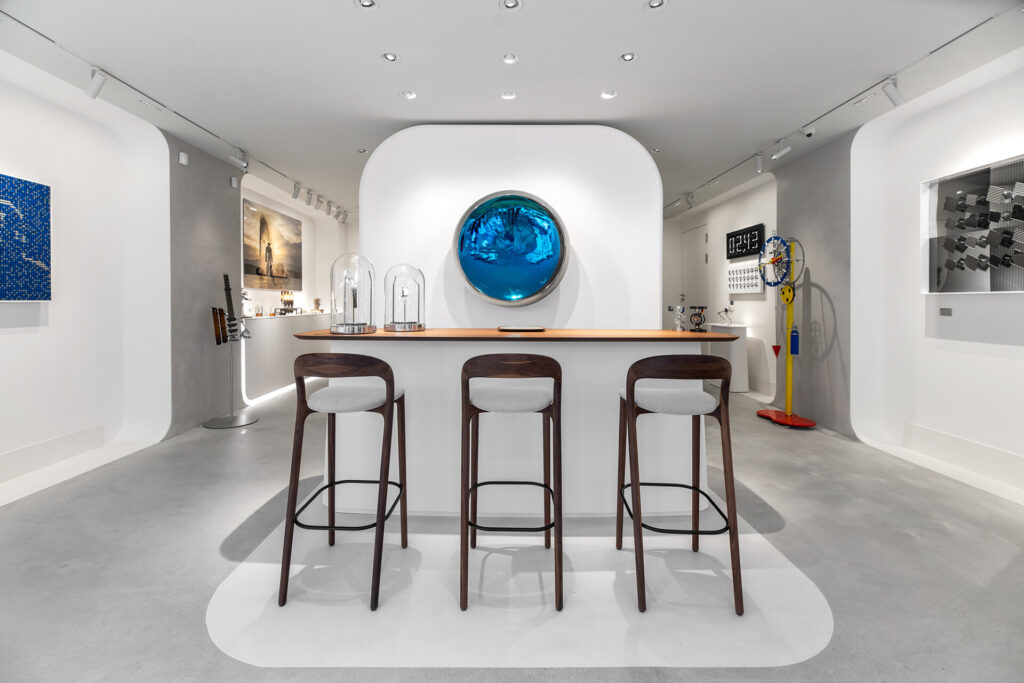
The M.A.D.Gallery, an acronym for Mechanical Art Devices, opened in Geneva’s Old Town in 2011. The concept found an audience quickly, and the gallery evolved from a single Geneva space into an international network. Today, M.A.D.Gallery operates alongside MB&F Labs in Taipei, Singapore, Paris, Beverly Hills, and Silicon Valley, with a further location in Dubai. The fifteenth anniversary of the original opening provides the occasion to reflect on that growth and, more tangibly, to release a series of limited-edition collaborative works.
A gallery built on unconventional principles
The original M.A.D.Gallery was born out of practical necessity rather than commercial ambition. MB&F’s Horological Machines, which are sculptural, mechanically complex objects that happen to tell the time, resisted classification. Neither watch retailer nor gallery owner had a suitable framework for presenting them. Building an independent space removed that constraint entirely.
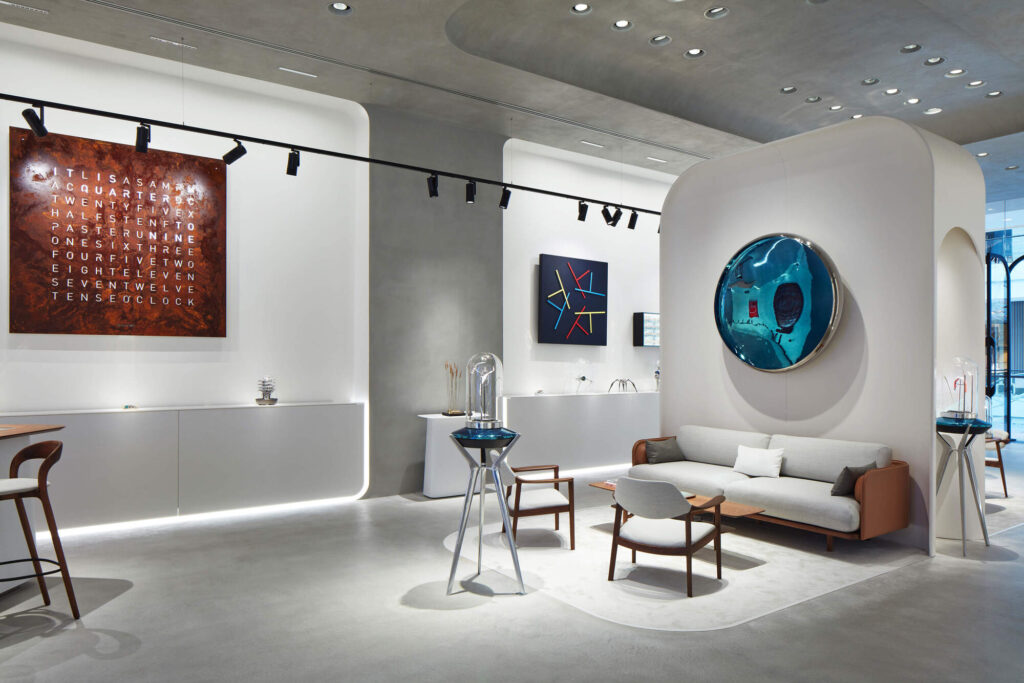
Beyond housing MB&F’s own work, the gallery was conceived as a platform for artists working in mechanical and kinetic sculpture, many of whom faced similar difficulties finding appropriate venues. The result was a community of makers connected by material thinking and a shared interest in objects that move, function, and reward close inspection. Over fifteen years, that community has shaped the gallery’s identity as much as any single piece within it.

The artist who helped build the beginning
To mark the anniversary, MB&F invited a number of artists who shaped the gallery’s early years to create special editions that will be unveiled progressively throughout 2026. The first is a collaboration with Berlin-based artist Frank Buchwald, whose association with the gallery dates to its inception. Büsser first encountered Buchwald’s work online, drawn to what he described as retro-futuristic Machine Lights, and subsequently visited the artist’s Berlin workshop.
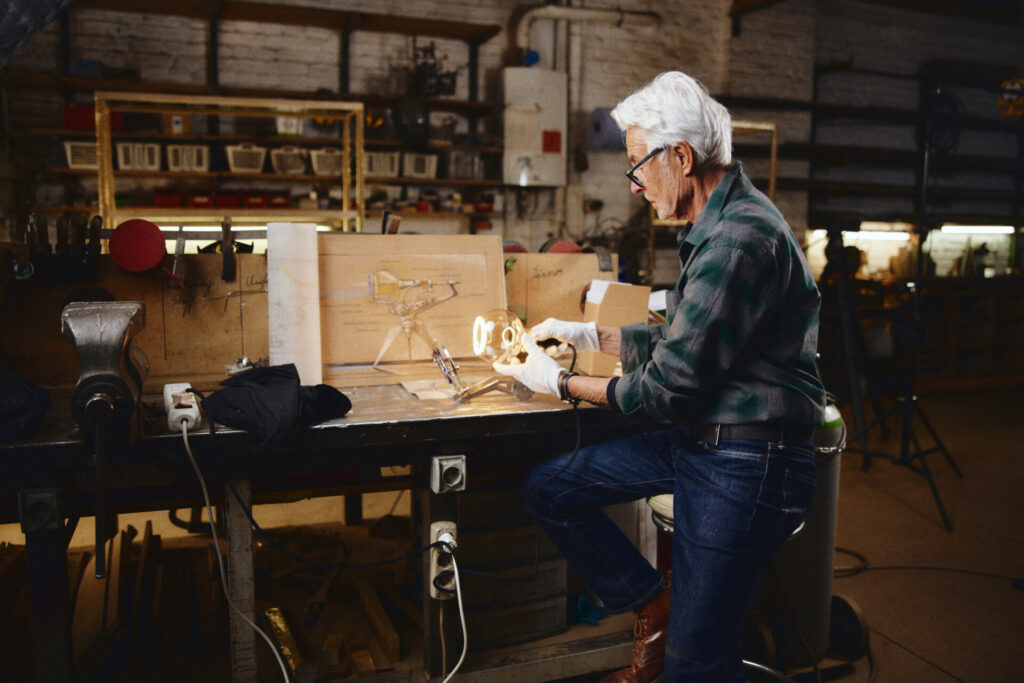
The studio occupied an old industrial building filled with brass, steel, sketches and machinery. The meeting produced an immediate connection. On the return journey to the airport, Büsser purchased the next ten pieces for the gallery that was yet to open. That early vote of confidence set the tone for a collaboration that has now run continuously for fifteen years.
The ML15 Helios: an anniversary edition
The anniversary edition is the ML15 Helios, a lamp conceived as a mechanical interpretation of the sun. A spherical lamp occupies its centre, surrounded by a luminous ring that references the appearance of a solar corona. Two transparent blue rings frame the central sphere, giving the object a quality that sits somewhere between a scientific instrument and something that appears to observe the room around it.
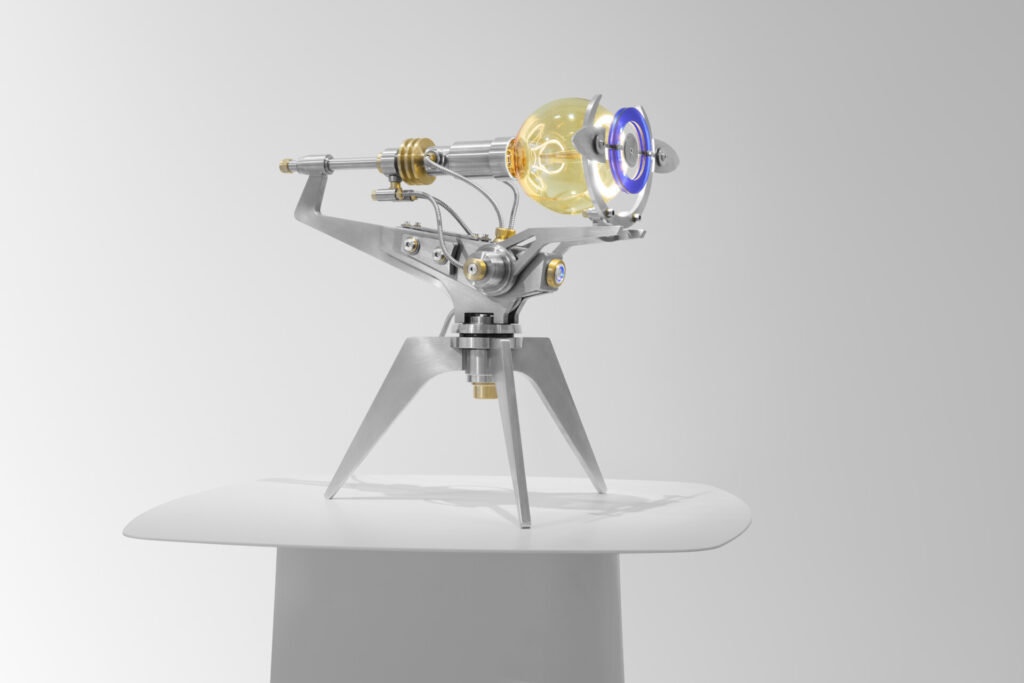
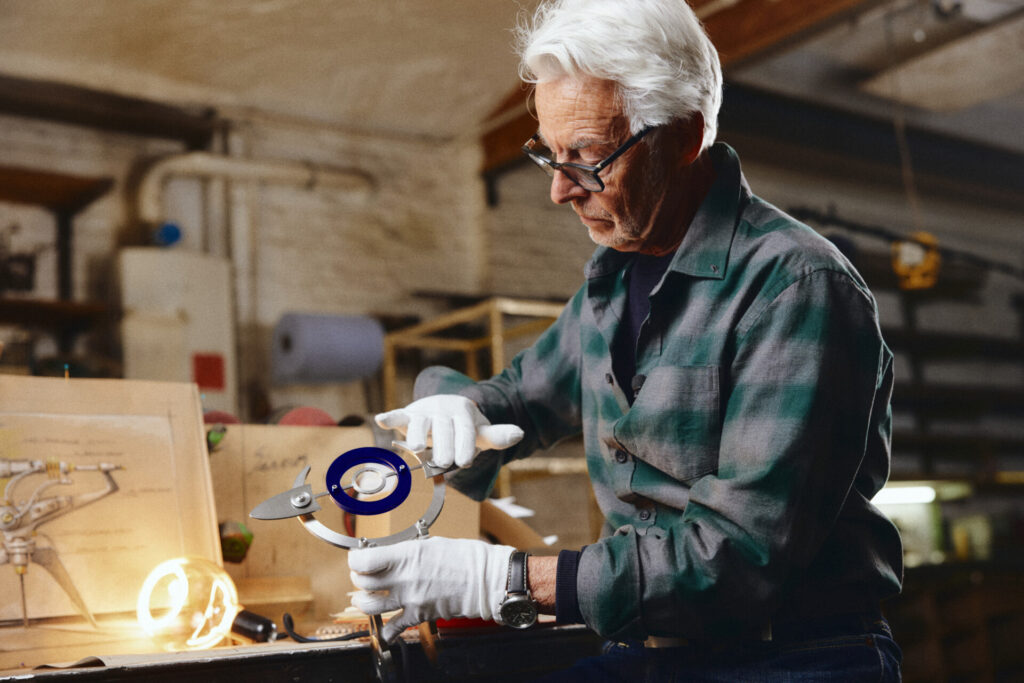
Limited to 15 pieces, the Helios is constructed from stainless steel with brass elements. It measures 350mm in width, 440mm in height, and 460mm in depth, with a total weight of 9kg. Like all of Buchwald’s output, it is entirely handcrafted. Even components that begin as laser-cut elements are manually reworked and refined before assembly begins. The production process continues well into the workshop phase, with proportions and details adjusted by hand until each piece reaches the maker’s own standard of completion.
Craft at the heart of the process
Each Helios takes several weeks to complete, and the majority of that time is not spent on assembly. The greater part of the production period is devoted to subtle refinements: adjusting, removing, and adding detail until the object achieves the balance Buchwald is looking for. The approach is characteristic of a body of work that has always prioritised the integrity of the finished piece over efficient production.
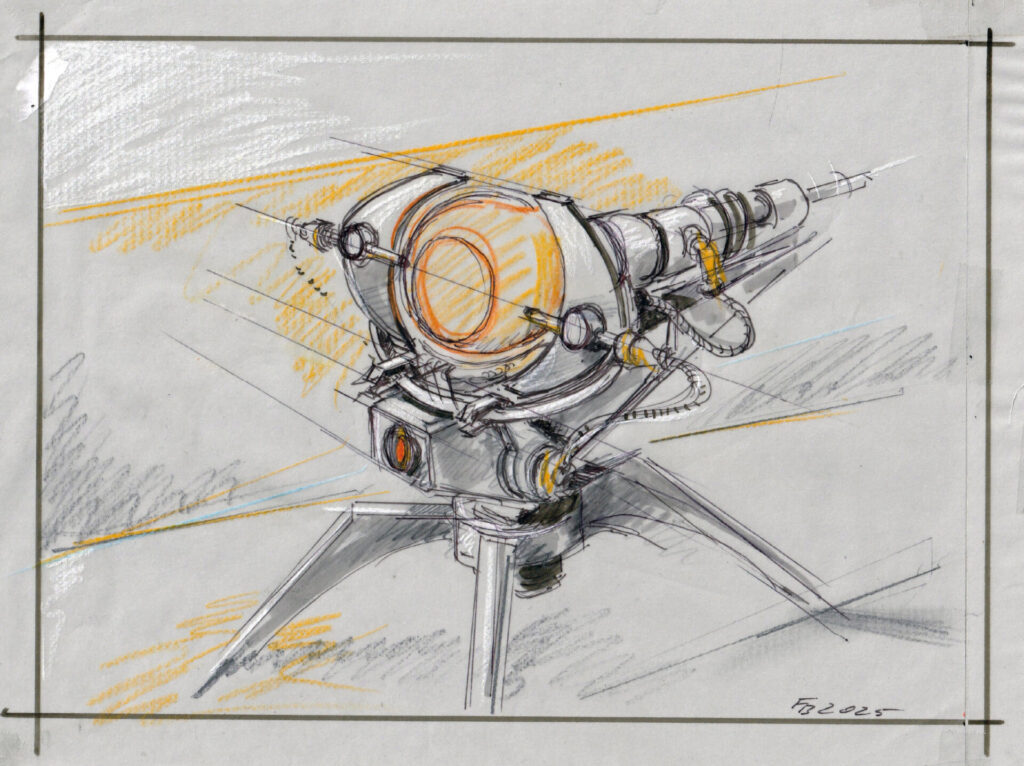
This combination of materials, scale, and hand-finishing places the ML15 Helios firmly within the tradition of objects the M.A.D.Gallery was built to celebrate: functional in origin, sculptural in presence, and defined by the individual attention of the person who made it. For a gallery that began by refusing to accept existing categories, it is a fitting anniversary statement.
Looking ahead from a fifteen-year foundation
The anniversary series will continue throughout the year, with further editions from artists who were part of the gallery’s formative period. The intention is less a retrospective and more an acknowledgement of continuity: the same ideas that drove the original opening in Geneva remain central to how the gallery operates across its locations today.
From a single space opened without a card payment machine to a global network with outposts across Europe, North America, and Asia, the M.A.D.Gallery has expanded without changing its fundamental character. The objects on its walls are still made by hand, still difficult to categorise, and still chosen because the people behind them share a conviction that the process of making matters as much as the object it produces.