


The new McLaren W1 follows two of the most significant supercars the company has ever built, the McLaren F1 and the McLaren P1, and it does justice to both. It is the third chapter in McLaren’s famous ‘1’ lineage, built with the same racing instincts that shaped the originals.

A 1275PS V8 hybrid powertrain sits at its core, backed by aerodynamics developed with genuine Formula 1 expertise and a McLaren Aerocell monocoque built using motorsport techniques. Together they make the W1 quicker in a straight line than the McLaren Speedtail and three seconds a lap faster than the track-focused McLaren Senna around McLaren’s own reference circuit.

Priced from around £2.0 million and limited to 399 examples, all already allocated to customers, the W1 sits at the very top of McLaren’s range. It carries the weight of the F1 and P1 with ease, and adds a new benchmark of its own.
Engineered for power
An all-new 4.0-litre twin-turbo V8, badged MHP-8, forms the core of the powertrain, producing 928PS on its own and a specific output of 233PS per litre, the highest ever from a McLaren engine. It revs to 9,200rpm, further than any road-going McLaren before it, and is paired with a 347PS electric module mounted to the side of the transmission. Combined output reaches 1275PS and 1340Nm, sent purely to the rear wheels through a new eight-speed dual-clutch gearbox and hydraulic differential.

The resulting performance is exceptional. Zero to 200km/h takes 5.8 seconds, 300km/h arrives in under 12.7 seconds, and top speed is electronically limited to 350km/h. All of that comes through the rear wheels alone, a deliberate choice that keeps the driver firmly in control.

“W1 is a supercar that embodies all of the fundamentals of performance, honed through decades of motorsport and supercar innovation. Underpinned by epic power and a light vehicle weight of just 1,399kg, W1 not only eclipses all other road-legal McLarens on both acceleration and lap times, it redefines supercar performance full stop.“
Marcus Waite, Head of Attributes and Performance, McLaren Automotive
Formula 1 aerodynamics
The aerodynamic package draws directly on Formula 1 thinking, using full underbody ground effect to generate up to 1,000kg of downforce. Race mode lowers the ride height by 37mm at the front and 17mm at the rear, while the McLaren Active Long Tail rear wing extends by 300mm to lengthen the diffuser and produce up to five times more downforce than the road setting.

McLaren logged at least 350 hours in the wind tunnel, tested 5,000 points and ran more than 3,000 CFD simulations to get there, work that has already led to several patent applications covering the active wings, the underbody and the monocoque. The result generates 20 per cent less drag than a McLaren Senna running its rear wing in DRS configuration.

“The McLaren W1 is the perfect execution of a bold and ambitious aerodynamic philosophy that delivers impressive lap times through not only high downforce but optimal aerodynamic behaviour and active control. Thanks to numerous innovations, we have succeeded in incorporating an elegantly F1-inspired vortical flow field into an uncompromised road car.“
Robin Algoo, Principal Aerodynamics Engineer, McLaren Automotive
Speed for a Supercar
The McLaren Aerocell forms the structural heart of the car, a carbon fibre monocoque built using pre-preg motorsport techniques for greater strength without added weight. It is McLaren’s lightest structure yet, helping the W1 reach a dry weight of just 1,399kg and a power-to-weight ratio of 911PS per tonne, the best the company has achieved. The doors mark a first too, swapping the dihedral design famous from the McLaren F1 for a new anhedral setup that frees extra cooling space for the front radiators.

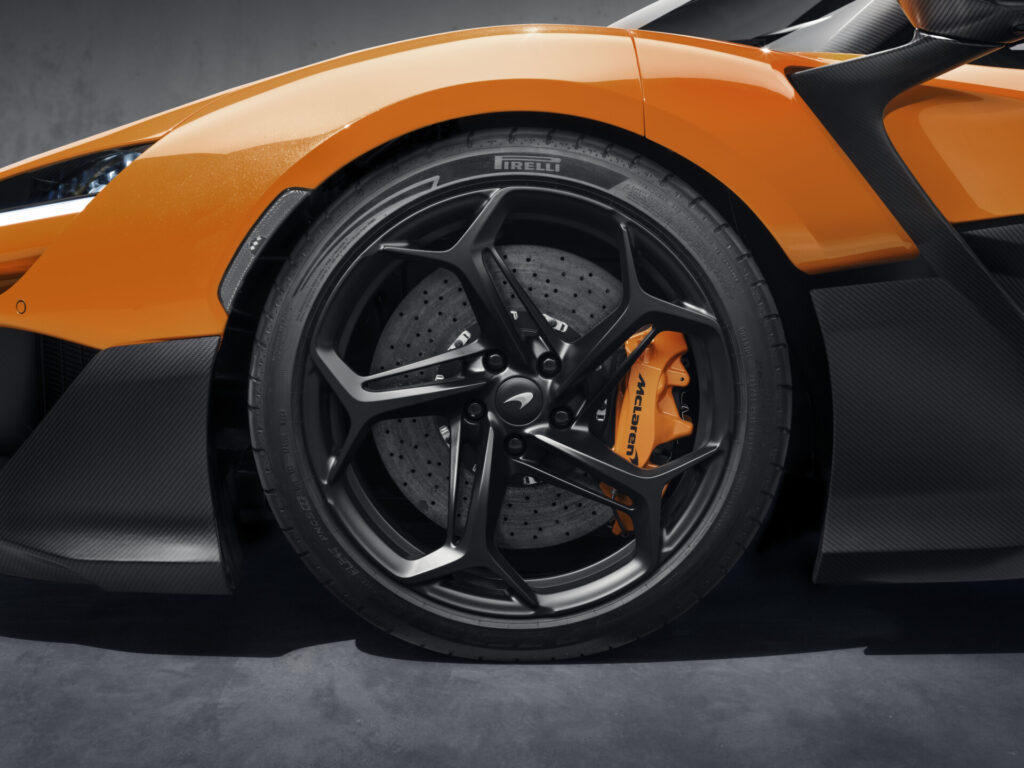
Braking comes from a carbon ceramic system with 390mm discs front and rear, six-piston calipers up front and four-piston items behind, capable of stopping the car from 200km/h in just 100 metres. The suspension, McLaren’s Race Active Chassis Control III, uses Formula 1-style inboard damping and heave control, with 3D-printed titanium components keeping unsprung weight to a minimum.
Cultivating craft in every detail
The driving position is fixed and built directly into the Aerocell monocoque, connecting the driver to the chassis more closely than in any previous McLaren. Visibility benefits from the narrowest A-pillars the company has fitted, and the steering wheel carries just two buttons, Boost and Aero Deployment, keeping the driver’s hands exactly where they should be. A Bowers & Wilkins audio system and an 8-inch touchscreen with Apple CarPlay bring everyday comfort to an otherwise single-minded machine.
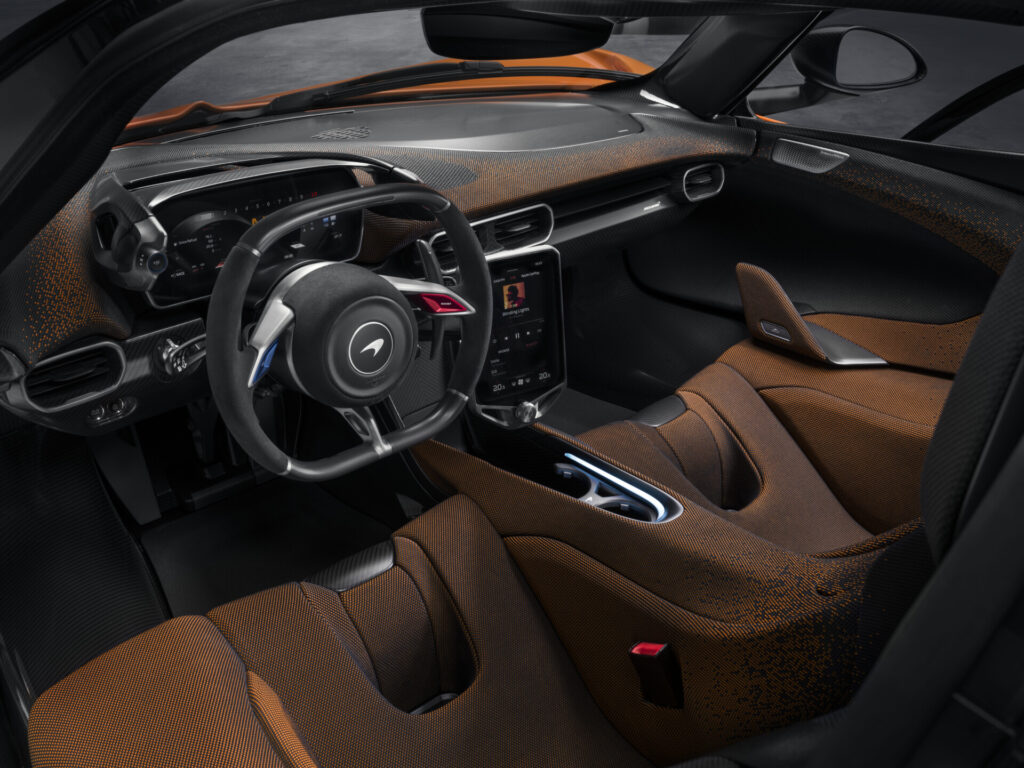
Personalisation runs just as far. McLaren Special Operations offers close to unlimited scope for bespoke finishes, including the new McLaren InnoKnit material, a knitted fabric shaped precisely to each interior panel with no wasted cutting or stitching. Leather, Alcantara and carbon fibre trim round out the options, giving each of the 399 cars its own identity.
“The W1 is immediately and unmistakeably a McLaren. The shoulder-line leaping forward, the pronounced wheelarches, the sunken cabin and the short overhang and open structure at the rear of the car are all pure McLaren design characteristics, defining an extraordinary new supercar that will have its own chapter in McLaren history.“
Tobias Sühlmann, Chief Design Officer, McLaren Automotive