


Bugatti’s Sur Mesure department specialises in taking a remarkable car and making it entirely unique. With ‘Blanc Éternel’, that expertise has produced a single W16 Mistral roadster, brought to life through a close collaboration with Königliche Porzellan-Manufaktur Berlin, known as KPM, the celebrated porcelain house based in the German capital. It revives a partnership between the two houses that began fifteen years ago, and in doing so beautifully connects the beginning and the end of one of Bugatti’s most significant engineering chapters.
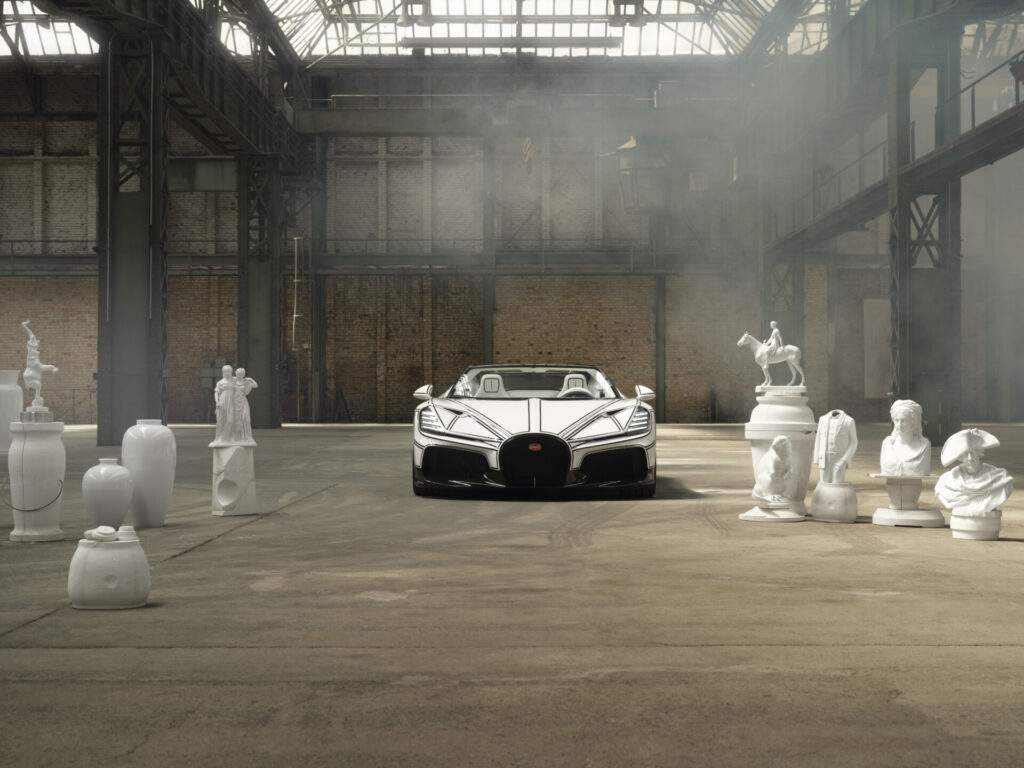
“With this renewed partnership between Bugatti and KPM, and one of the final expressions of our legendary W16 era that it has yielded, we pay tribute to an intricate and emotional chapter in Bugatti’s modern history. ‘Blanc Éternel’ and the accompanying porcelain artworks demonstrate that true luxury is the opportunity to create something meaningful and precious, rooted in heritage and realised without compromise.”
Hendrik Malinowski, Managing Director, Bugatti
The relationship between Bugatti and KPM dates back to ‘L’Or Blanc’, a porcelain-inspired take on the Veyron Grand Sport created in collaboration with the Berlin manufacturer. It stood out at the time for the sheer care taken over its materials, and for a design that had to be applied to the car entirely by hand. Frank Heyl, now Bugatti’s Design Director, worked directly on that original project, tracing its lines across the bodywork himself.

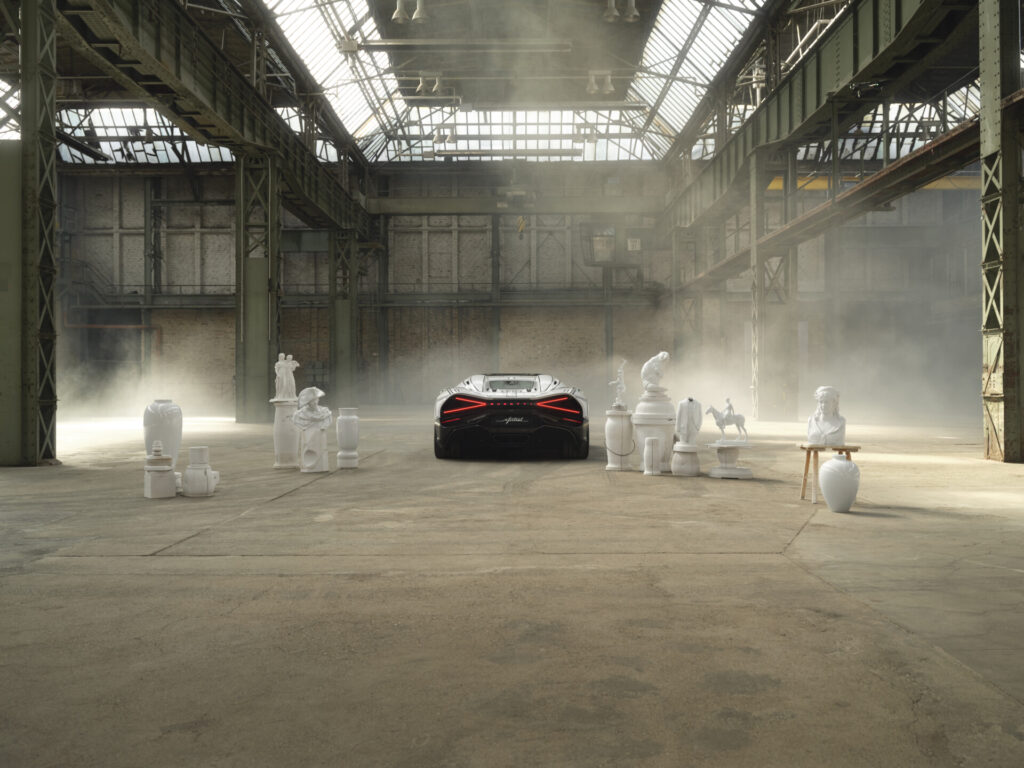
The look was inspired by a porcelain vase that KPM had produced with the Italian designer Enzo Mari, finished in white with confident, flowing strokes of royal blue. Bugatti’s designers took that same simplicity and applied it to the far more complex surfaces of a hyper sports car, using the lines of light that engineers rely on to check a body’s curvature as their starting point. On ‘L’Or Blanc’, those working lines became the artwork itself.
A Digital Design
The W16 Mistral was designed without a single clay model, built instead through a fully digital process using NURBS, or Non-Uniform Rational B-Splines, a method of constructing complex surfaces from a network of precisely controlled curves. Those individual surface patches are usually invisible once a car is finished, hidden beneath the smooth panels that make up the final shape. On ‘Blanc Éternel’, that hidden structure becomes the entire point.
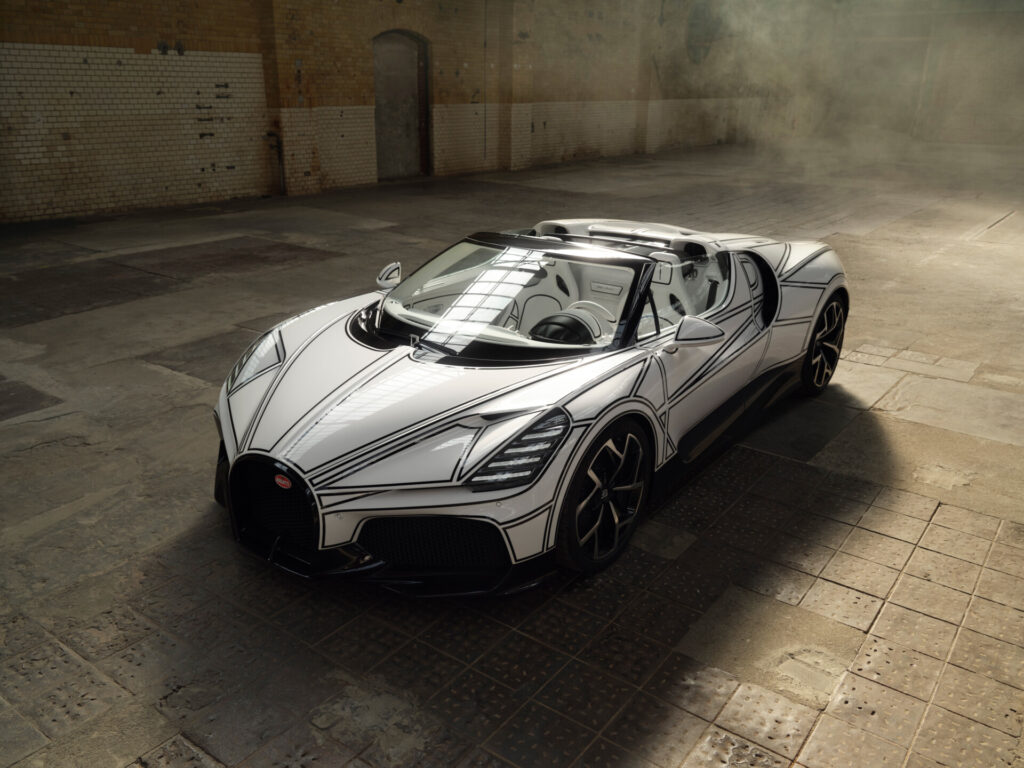
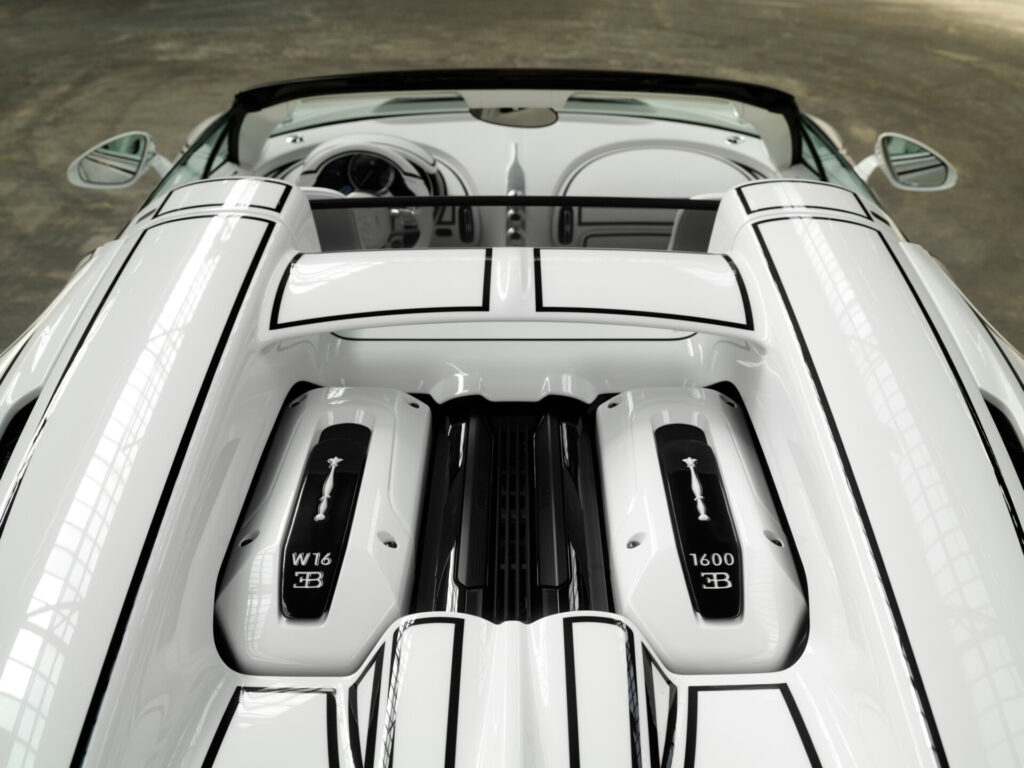
Fine black lines follow the underlying patch layout across the bodywork, tracing the geometric logic that shaped the car in the first place. Rather than repeat the reflection-line artwork of ‘L’Or Blanc’, Bugatti’s design team chose to reflect how the process of designing a Bugatti has itself moved on. The contrast of black against white nods to the language of digital modelling, while the name ‘Blanc Éternel’ points to both the white porcelain that inspired it and the closing chapter of the W16 within Bugatti’s history.
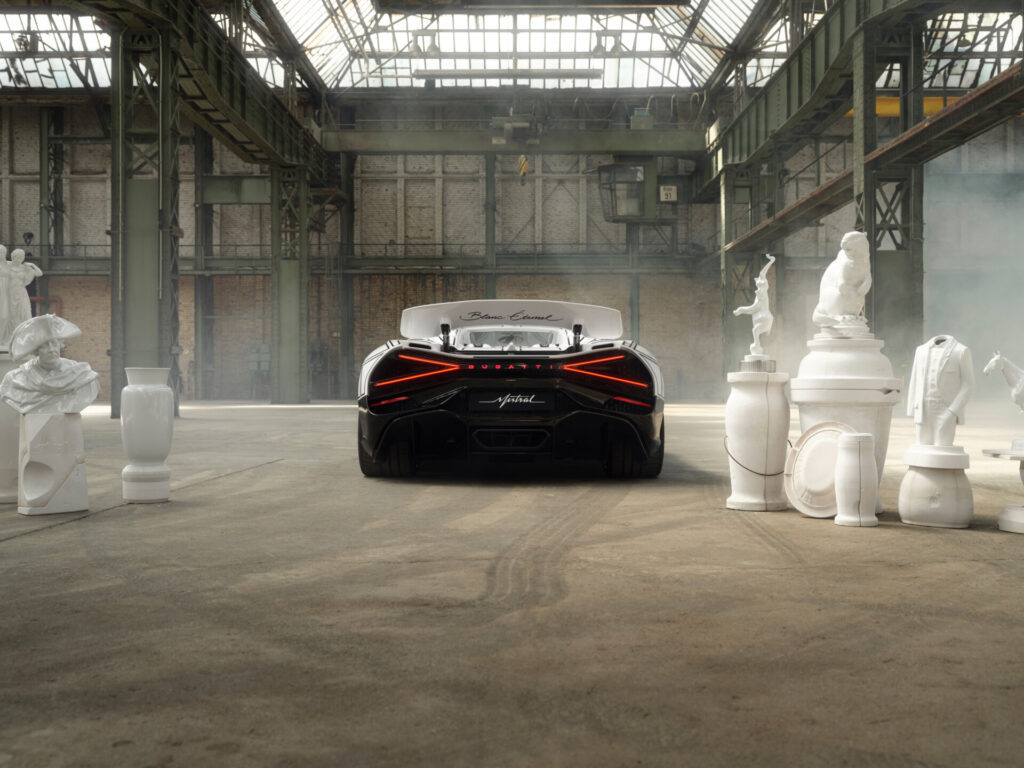
Painted by hand
For all its digital origins, the finished car is the product of entirely manual work. With no clay model to reference, every line had to be positioned directly onto the actual W16 Mistral once it left the production line.
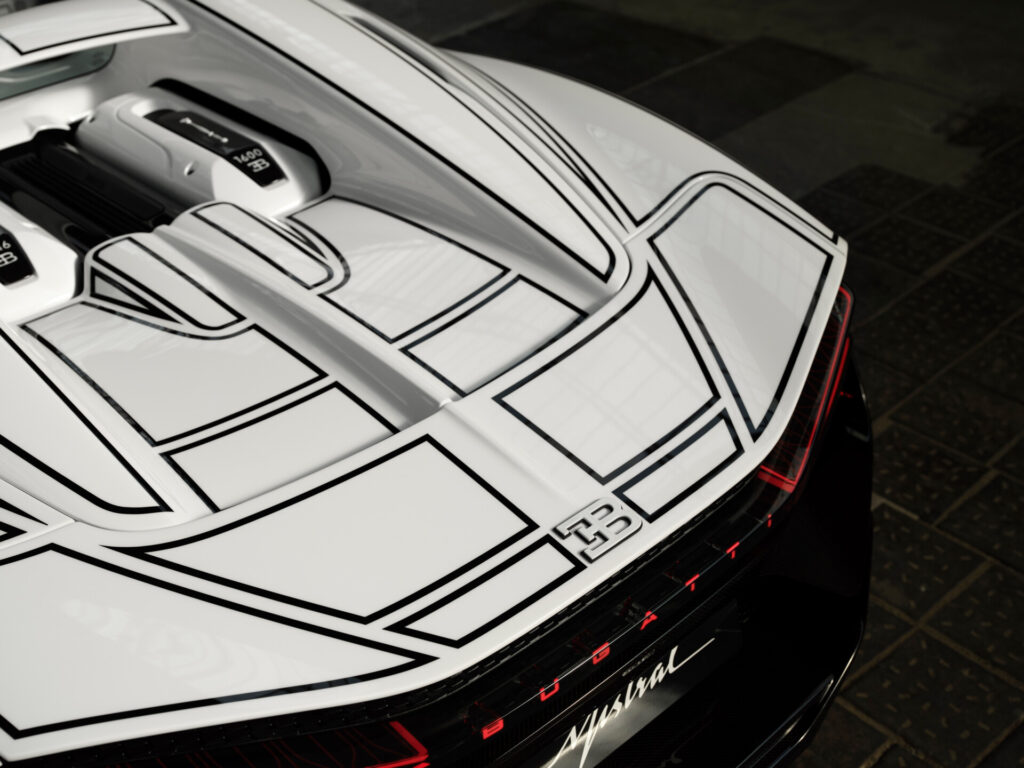
The body is first finished in white and sanded smooth, before each black line is marked out with precisely applied tape. The surrounding areas are then counter-masked, the original tape removed, and the exposed channels sprayed black, a sequence repeated across every panel until the full design has travelled across the car’s three-dimensional surfaces.
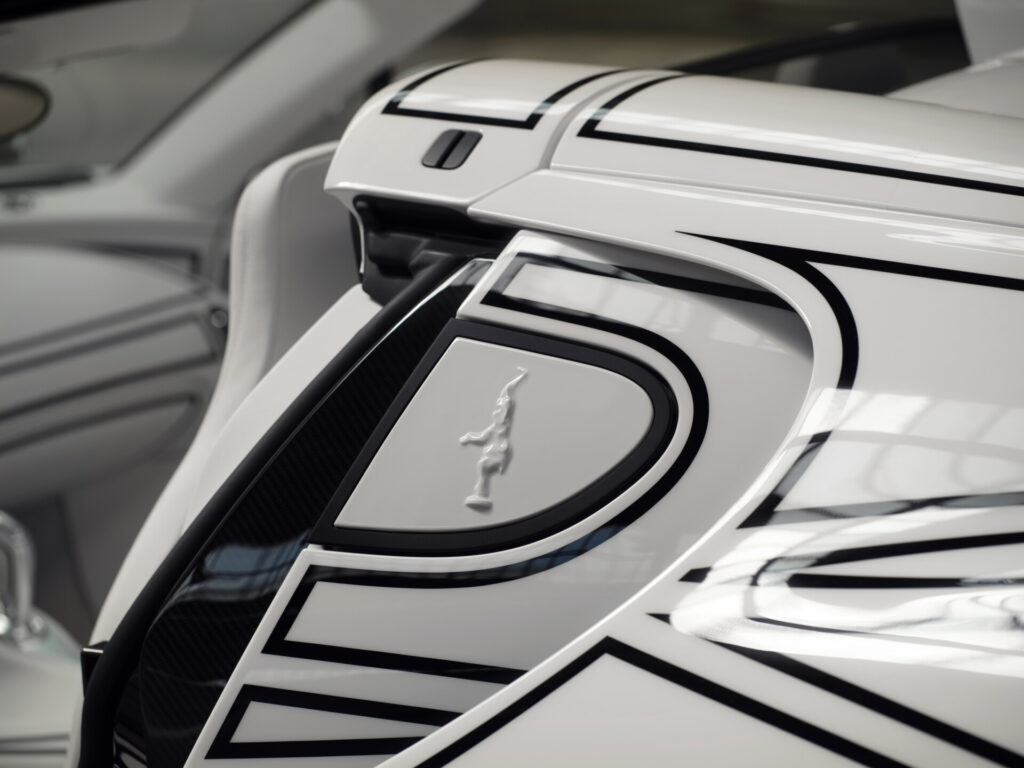
The effect draws the eye through the Mistral’s signature details, from its horseshoe grille and rising C-line to its air intakes and X-shaped taillights, each one appearing simultaneously sculpted and technically exposed.
“The W16 Mistral ‘Blanc Éternel’ is exceptionally beautiful because every line and every material has a purpose. Bringing the car to life required an intricate collaboration between our Bugatti design team in Berlin and the experts and leadership at KPM. ‘Blanc Éternel’ respects Bugatti’s history without being constrained by it, fusing our heritage with individual taste in a way that feels wholly new.”
Frank Heyl, Design Director, Bugatti
Precision in porcelain
Genuine porcelain appears across the exterior in a series of precise details, among them the EB emblem, the fuel and oil filler caps, and two inlays set into the engine cover bearing KPM’s royal sceptre logo. Producing pieces this small to this level of accuracy is no simple task. Porcelain shrinks as it is fired in the kiln, with the finished dimensions differing by seventeen per cent from the unfired component, a change that has to be calculated in advance so that every piece fits its exact position on the car.
“I am proud and excited that, after 15 years, this collaboration has once again brought together two of my greatest passions: porcelain and automobiles. KPM and Bugatti represent the perfect fusion of master craftsmanship and engineering excellence.”
Jörg Woltmann, Owner, KPM
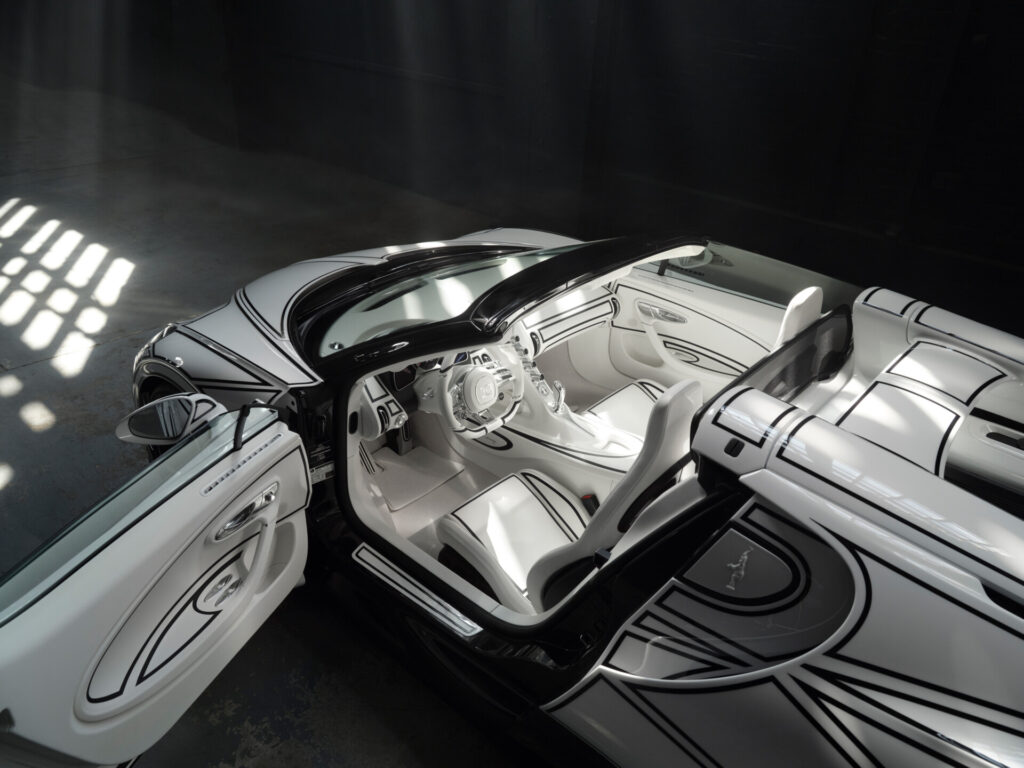
That same material continues inside the cabin, where it becomes something the driver actually touches rather than simply looks at. The speaker cover plate, two kneepad inlays, the gear-shifter shells, the centre-console armrest inlay and the window-lifter buttons are all crafted from porcelain, meaning a gear change or the resting of an arm brings the driver into direct contact with the material.
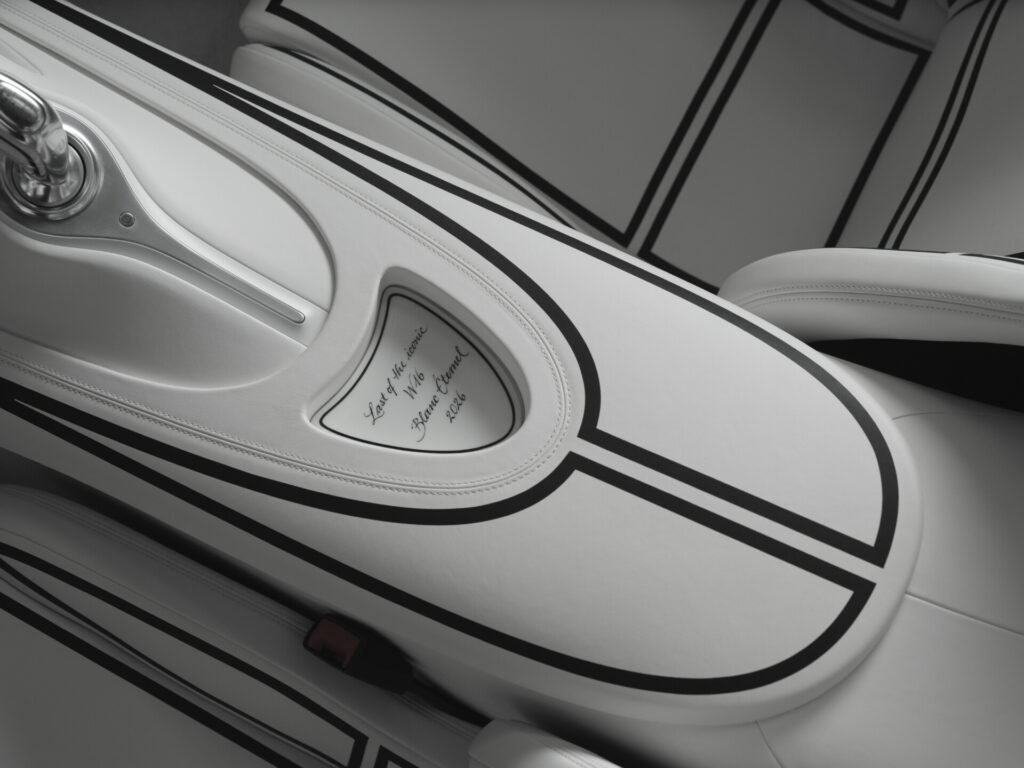
“The combination of delicate porcelain and uncompromising hypercar performance once again proved to be an extraordinary creative challenge. Refining such a sensitive material for use in a vehicle of this performance class represents a remarkable achievement in craftsmanship.”
Thomas Wenzel, Creative Director, KPM
Inside the cabin
The graphic language of the exterior continues onto the seats, where the black linework is reproduced directly onto white leather. Achieving the sharpness and durability needed for this effect required Bugatti to develop an entirely new process for the marque.
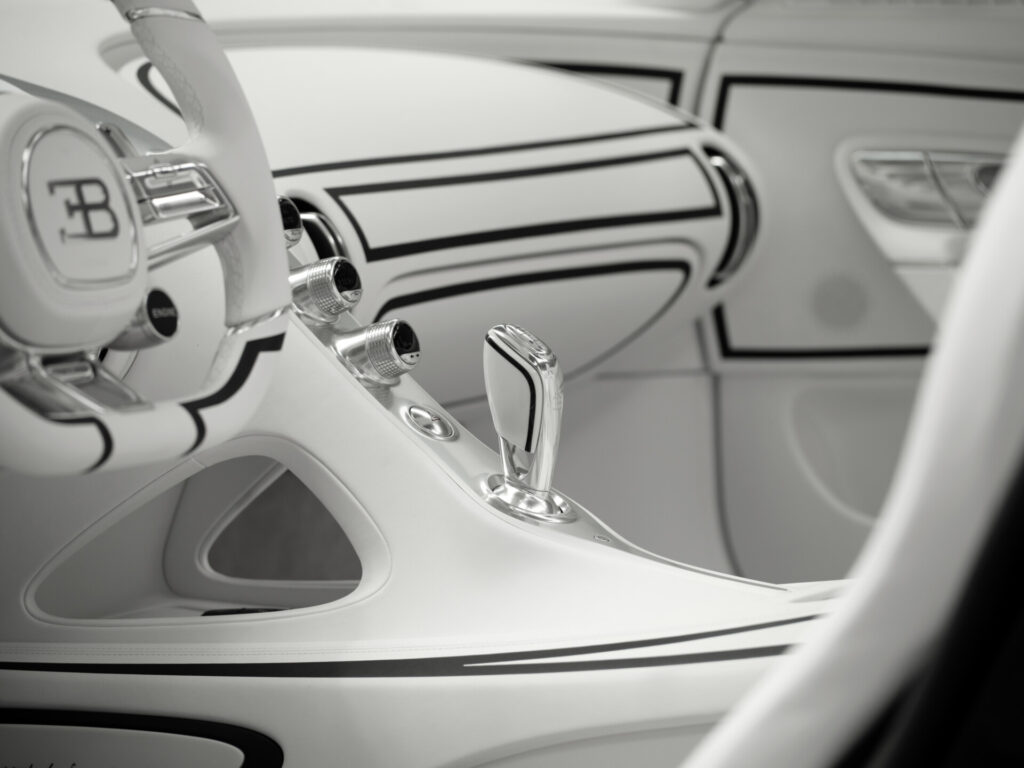
Each leather section is prepared individually before the line pattern is laid out and masked by hand, with black paint then applied directly onto the white leather to match the contrast seen outside the car. It is a slow, exacting process, and one that leaves the cabin feeling like a continuation of the exterior artwork rather than a separate space entirely.