


Rolex has unveiled the Perpetual Padellone in Milan, a complete calendar watch that combines an instantaneous annual calendar with a moonphase display. Housed in a 39 mm case of 18 ct Everose gold or 950 platinum, it shows the day, date, month and phases of the Moon alongside the time. At midnight, the entire calendar changes at once, in a fraction of a second.
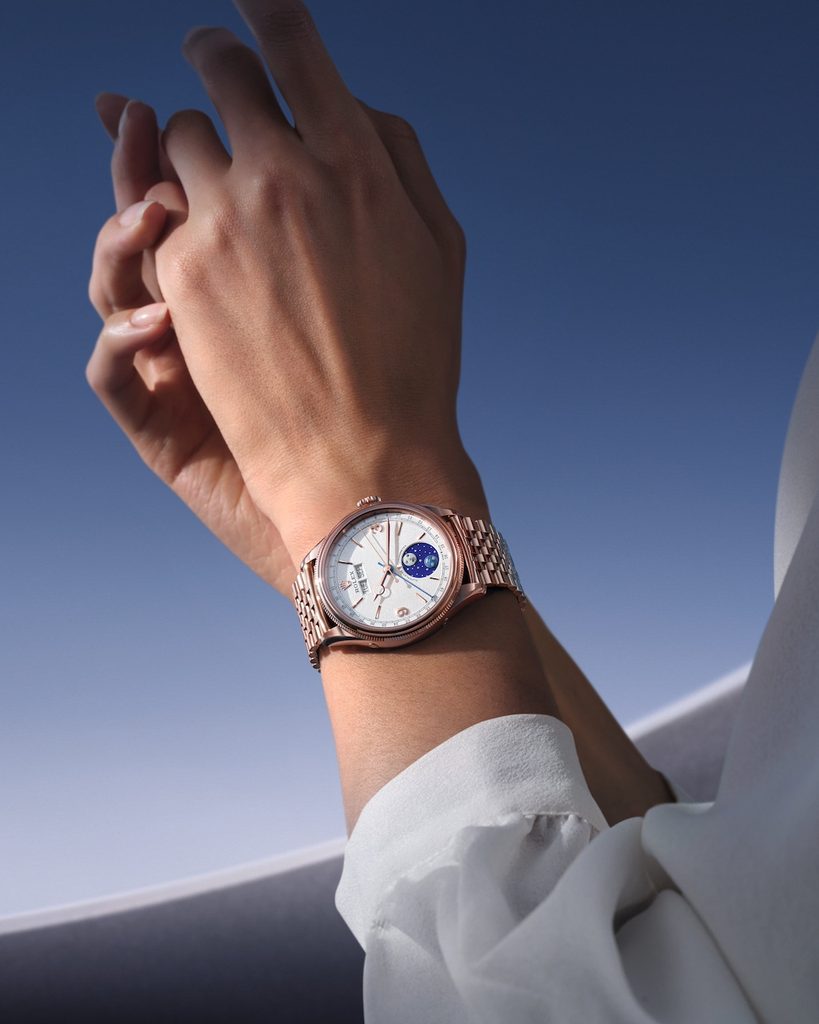
The inspiration is reference 8171, a model offered from the late 1940s to the early 1950s. Collectors named it the ‘Padellone’, Italian for a large frying pan, and have long admired its cheerful Moon depicted with a face among the stars. That character now returns in the second watch of the Perpetual collection, launched in 2023 with the 1908.

Calibre 7190 beats at 5 hertz and introduces the patented Haplos system, meaning the calendar needs adjusting only once a year. With 30 patent applications behind it, two of them exclusive to this watch, the Padellone is a 1940s favourite with a modern mind.
Thanks to the Haplos system, the calendar is annual and recognises the difference between 30-day and 31-day months. It asks for attention only once a year, when February turns to March. Resetting the date at the start of each month simply becomes a thing of the past.

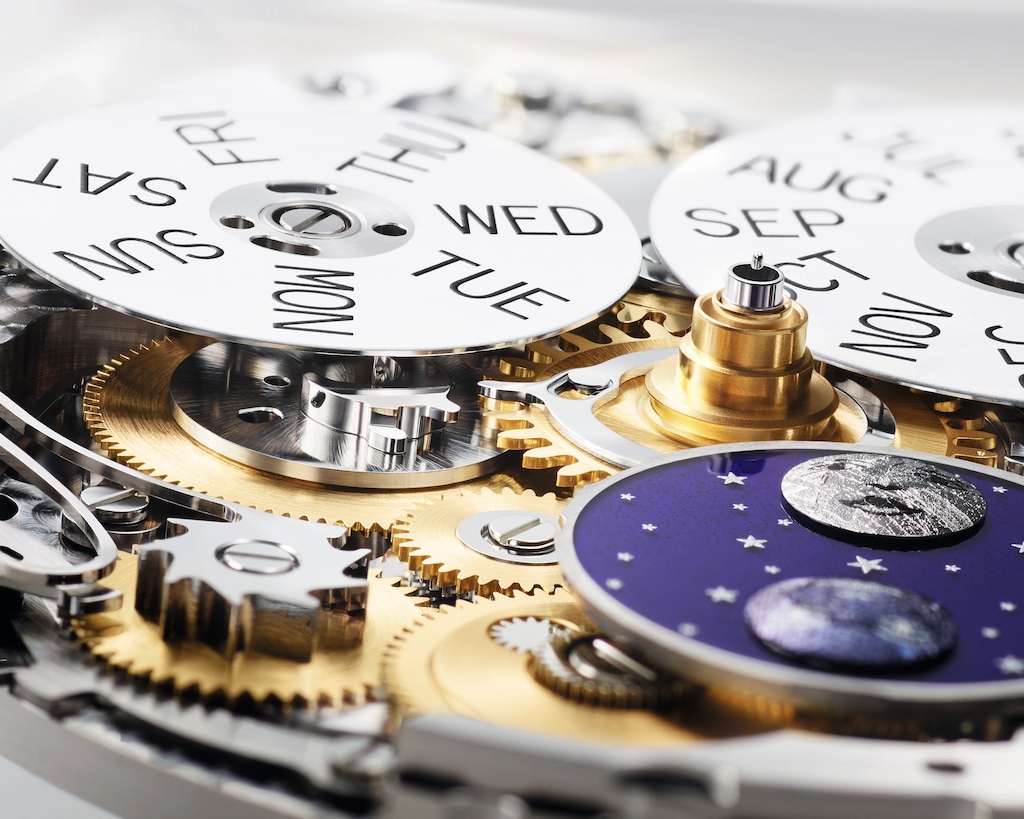
Speed is its other great strength. Rather than edging forward over several minutes, the day, date and month change together in the blink of an eye, a feature for which the brand has filed a patent application. Should any adjustment be needed, four correctors on the sides of the case can be operated with a correction stylus at any time, without affecting the movement.
Moonphase Face
The moonphase is one of the watch’s most engaging details. It sits on a fully visible blue enamelled disc that completes one rotation every lunar month, or 29.53 days. Instead of concealing a single Moon behind a shaped cover, as traditional displays do, the Padellone uses two representations crafted from meteorite, with the new moon finished in a dark blue PVD coating.

As the disc turns, each aligns in turn with a small triangular indicator, tracing the time from one new moon to the next. Both carry a pad-printed face, an affectionate nod to reference 8171. It is a touch of warmth that gives the watch real personality.
A 1940s classic reborn
The design honours the original while bringing it to modern day. The 39 mm case has soft, graceful lines, and the bezel is domed at the top with fine fluting around its lower edge. The dial combines a grained finish at the centre with a fine satin finish around the outer track.
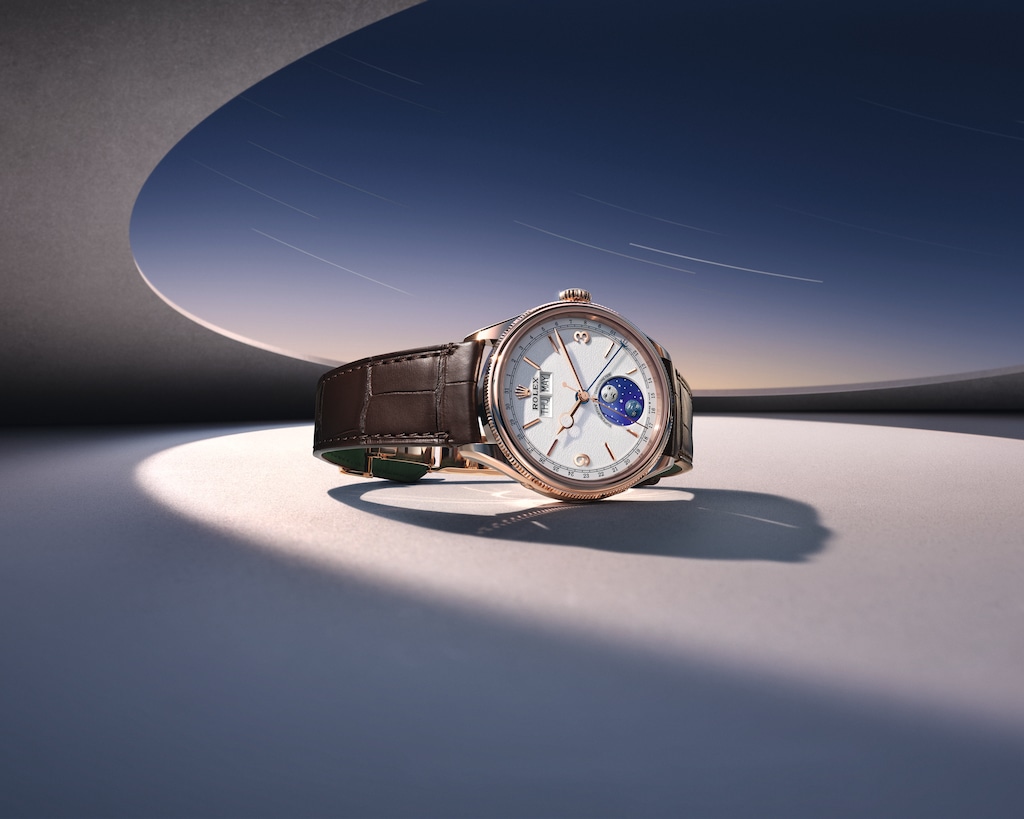
The watch is available on an alligator leather strap or a Settimo bracelet in 18 ct Everose gold. Introduced in 2025 on the Perpetual 1908, the Settimo is composed of rows of seven very small, slightly contoured links. It sits remarkably light on the wrist and echoes the jewellery-inspired bracelets found on some vintage watches.

The lead model is cased in 18 ct Everose gold with a grained-finish, intense white dial and the Settimo bracelet. Gold from lug to clasp, it makes the boldest statement of the trio.

A second Everose gold version keeps the intense white dial but swaps the bracelet for a brown alligator leather strap, giving a softer and more traditional feel. The third is cased in 950 platinum with a grained-finish, ice blue dial and a matt black alligator leather strap. Ice blue has long been the brand’s quiet signal of platinum, and it sits comfortably beside the deep blue of the moonphase.
The movement within
Turn the watch over and calibre 7190 is on view through the transparent case back. A cut-out oscillating weight in yellow gold, bridges decorated with Rolex Côtes de Genève and a considered interplay of finishes reward a closer look. Developed and produced entirely in-house, the movement is an evolution of calibre 7135, introduced in 2025 with the Land-Dweller.
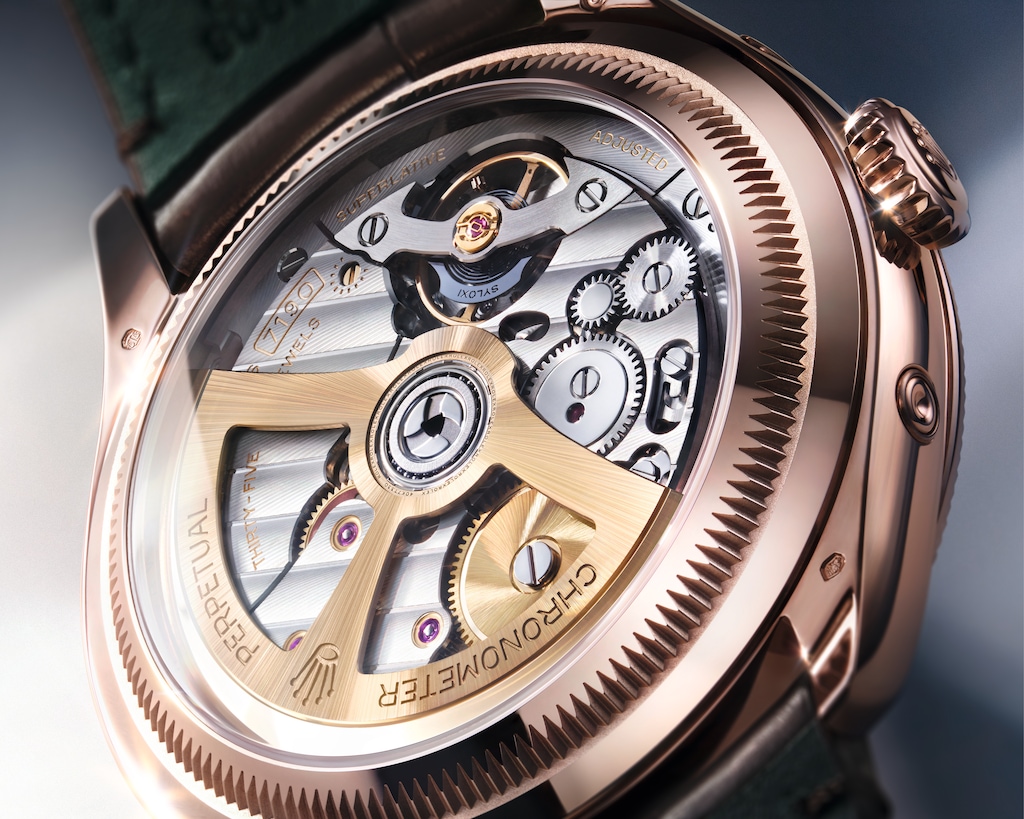
Like its predecessor, it beats at a high frequency of 5 hertz. It is fitted with the Syloxi hairspring in silicon, a ceramic balance staff and the Dynapulse escapement, also made of silicon. Together they deliver strong resistance to magnetic fields and outstanding performance in precision, power reserve, convenience and reliability.
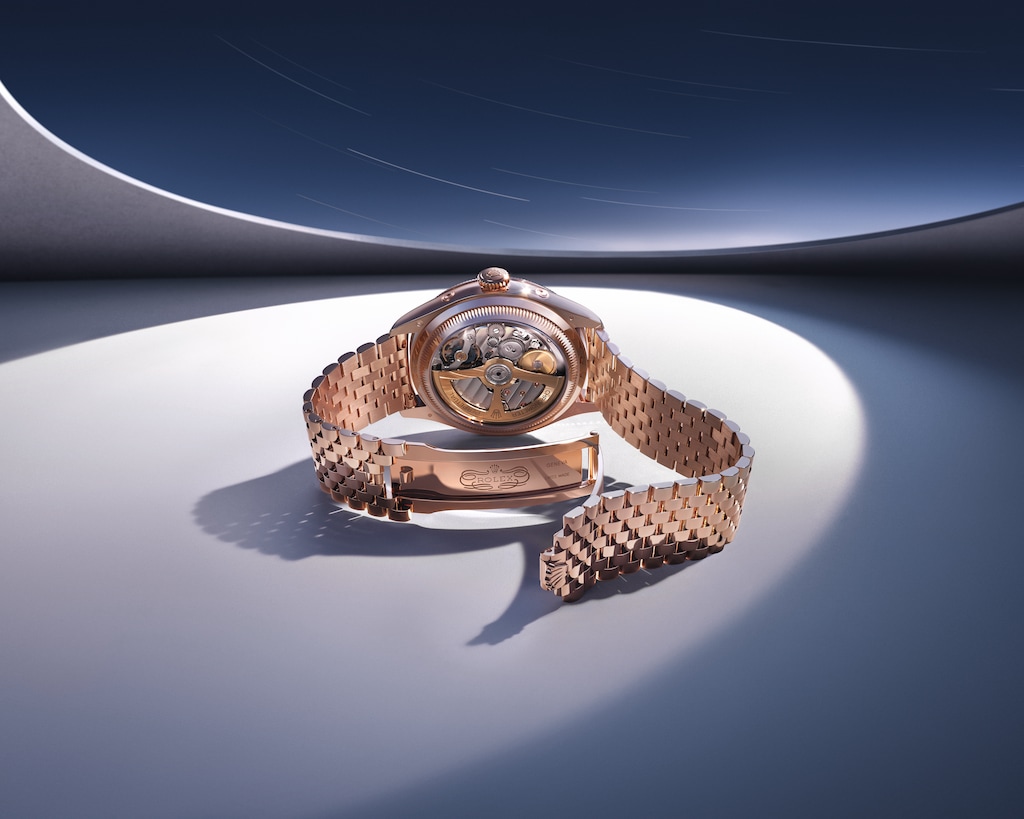
The Haplos system is the centrepiece. It adds just two components to the date mechanism, an additional carrier finger and an annual lever. The calendar programme is built into the reverse side of the month disc, informing the lever of the current month. Resolving the uneven months with two small parts is engineering of admirable elegance.
Certified to a higher standard
The Padellone joins the 1908 in the Perpetual collection and shares its defining qualities. Clean displays, noble materials and a movement proudly visible through the case back all draw on the brand’s know-how and design heritage.
Like every watch in the collection, it carries the Superlative Chronometer certification and its distinctive green seal. The standard was redefined in 2015 around precision, waterproofness, self-winding and autonomy, and in 2026 it was strengthened with three new criteria, namely resistance to magnetism, reliability and sustainability. Testing takes place in the brand’s own laboratories and is periodically validated by independent external organisations.
A tradition of firsts
The Padellone comes from a watchmaker with a long record of innovation. Guided by the ethos of its founder, Hans Wilsdorf, the Geneva-based brand launched the Oyster, its first waterproof wristwatch, in 1926, and invented the Perpetual rotor self-winding mechanism in 1931. More than 700 patents have followed over its history.
Today the maison designs, develops and produces most of its components across four sites in Switzerland, from casting its own gold alloys to finishing the movement, case, dial and bracelet. A fifth Swiss site is under construction and due to open in 2029. Given the 30 patent applications behind this single calibre, the additional space looks well timed.